Guide · Mesa, Arizona
Mesa epoxy flooring guide: costs, systems and slab prep
Epoxy flooring in Mesa lives with 106 F July afternoons, a slab that expands and contracts with the heat, and tires that can come off a drive above 200 F. Here is what decides whether the coating survives it, what the work costs, and what to settle before the slab is ground. Tell us about the slab and we call you back:
Costs
What an epoxy floor costs in Mesa
Published national data puts an epoxy floor in Mesa at $4 to $10 per sq ft installed, which is $1,600 to $5,800 for a 2-car garage (HomeGuide (opens in a new tab)). The spread is not haggling room. It is the difference between a 3 to 5 mil roll-on coat and a 20 to 30 mil flake build, and between a slab that only needs grinding and one that needs cracks filled before anything goes down. Family Handyman puts professional epoxy floor installation at $3 to $12 per sq ft (Family Handyman (opens in a new tab)), Fixr puts thick coat epoxy at $10 to $15 (Fixr (opens in a new tab)), and an epoxy flooring guide puts all professional systems at $3 to $15 for 2026. Bob Vila's national average is $2,441 for a garage (Bob Vila (opens in a new tab)). A national average carries no Mesa slab in it, and a thin coat and a full flake build are not the same product. The cost page breaks the ranges down by system and garage size. Published ranges, not a quote.
Planning
The 2 numbers that decide whether a floor lasts
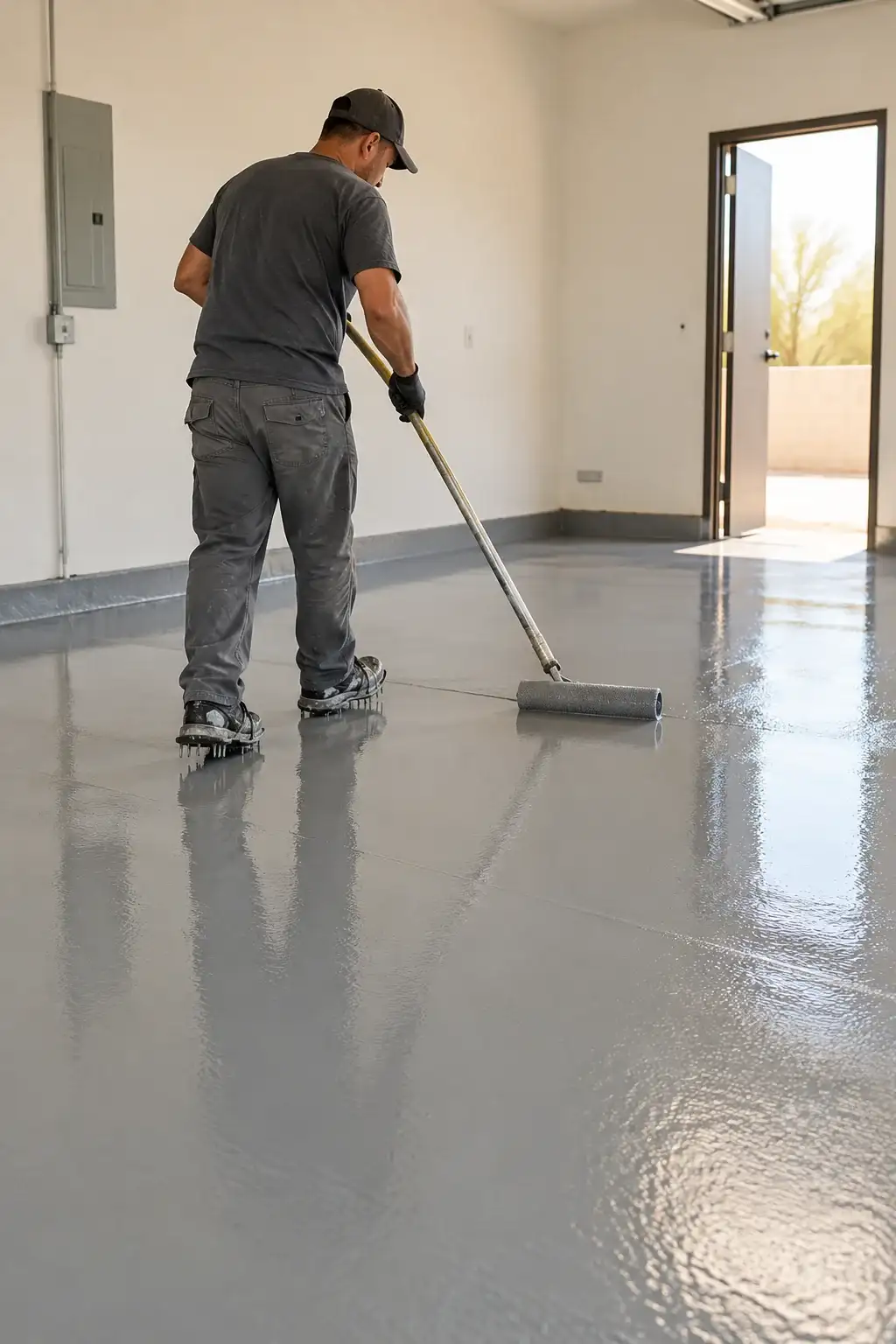
2 numbers decide it: dry film thickness in mils, and the moisture moving through the slab. Thickness comes first. A box-store kit leaves 3 to 5 mil, a two-coat solid epoxy leaves 10 to 20 mil, and a flake garage build leaves 20 to 30 mil (an epoxy flooring guide). A mil is one thousandth of an inch, so 5 mil is 0.005 inch, and volume solids decide what you actually get: a 50 percent solids coating rolled at 6 wet mils leaves 3 dry mils. The second number is moisture. A slab reads under 75 percent relative humidity on an ASTM F2170 in-slab probe, or under 3 lb per 1,000 sq ft per 24 hours on ASTM F1869, before any coating goes down (an epoxy flooring guide). Moisture is the leading cause of coating failure, and a film over damp concrete will bubble or peel (a garage floor coating company's guide). The prep page covers what happens when a slab fails.
Timeline
How Mesa heat changes the schedule
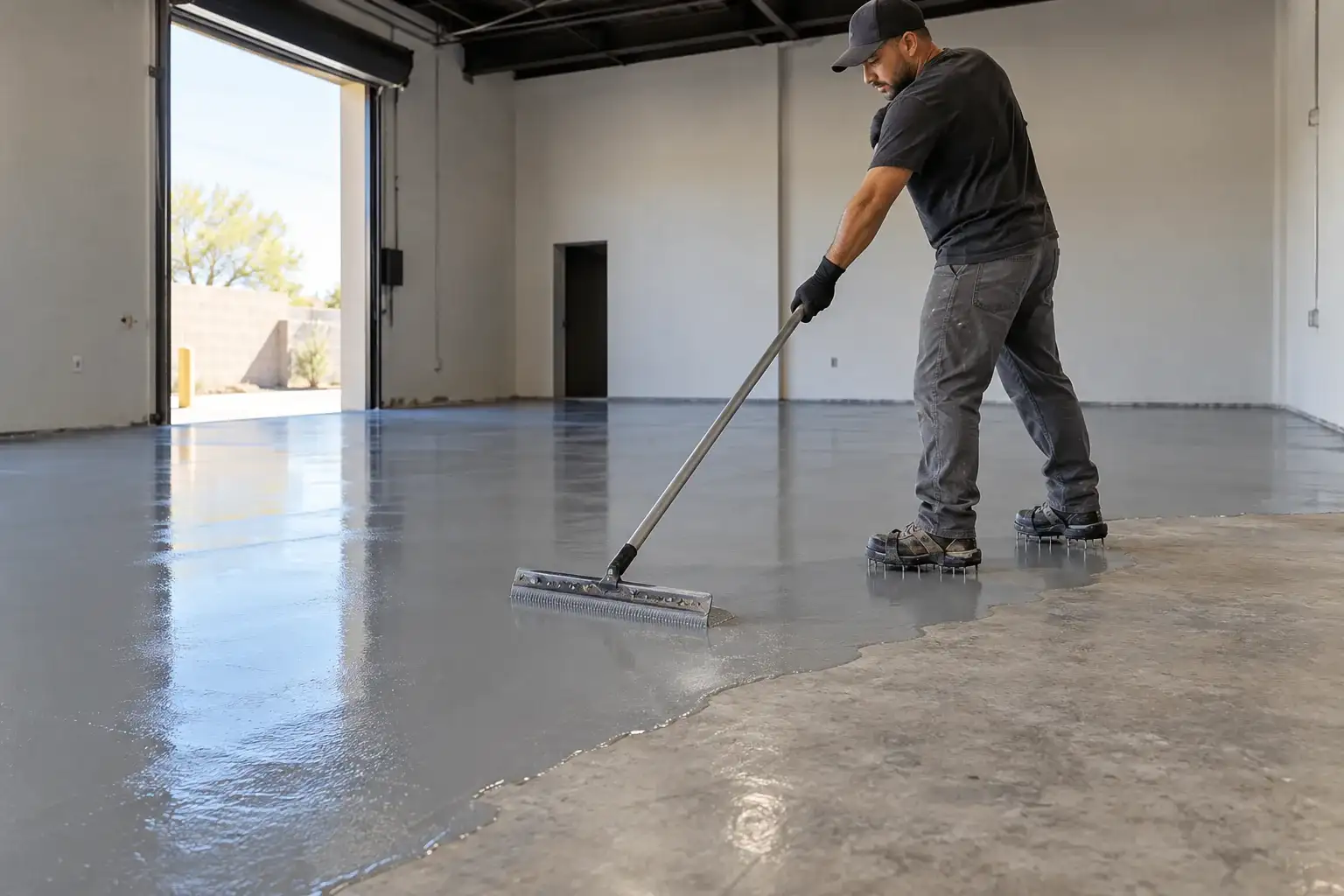
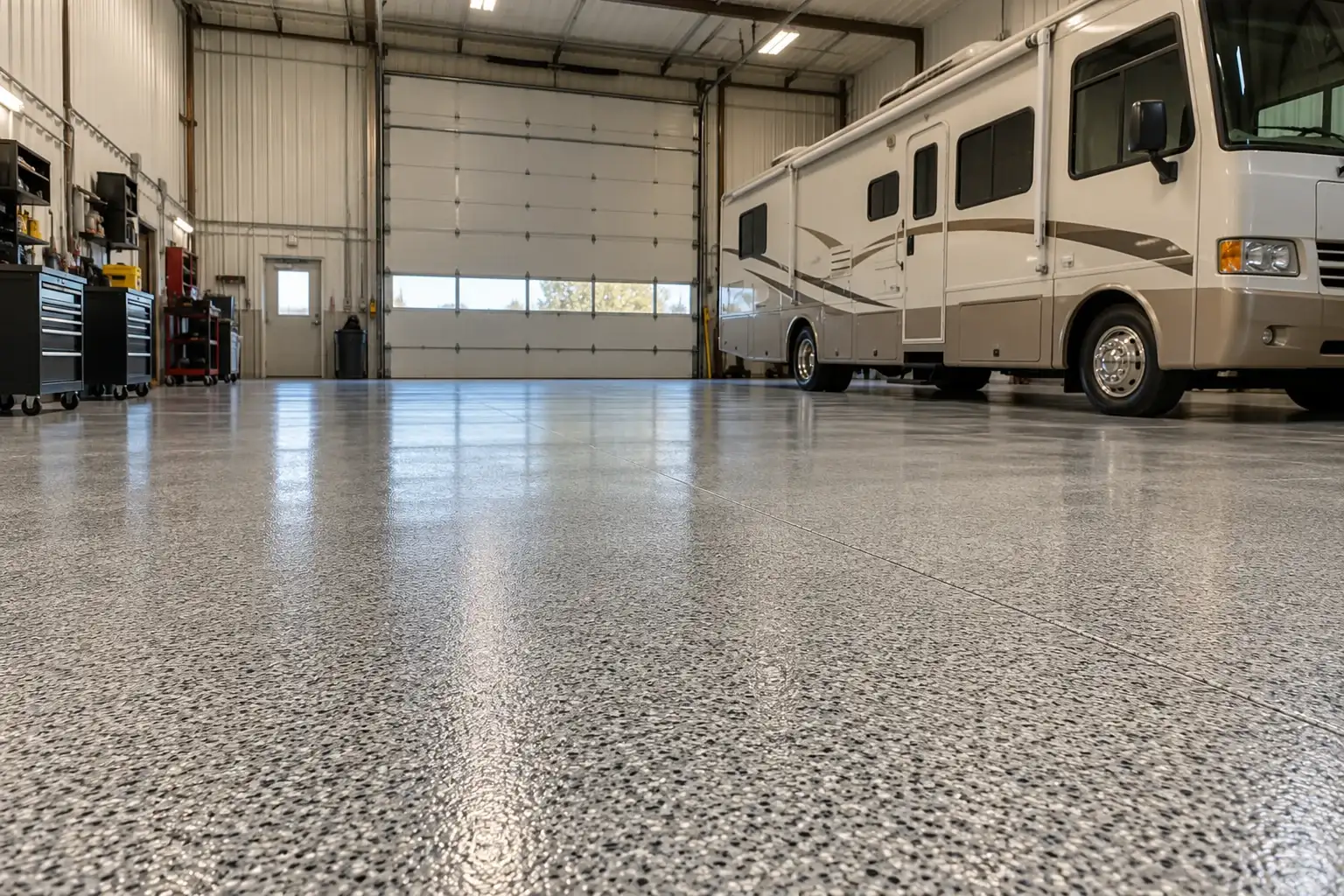
Mesa heat can move the work to the morning. Epoxy coatings call for installation temperatures between 50 F and 90 F (a garage floor coating company's guide), and July in Mesa runs a normal high of 106 F and a normal low of 79 F, with 1.18 in of rain (NOAA NCEI (opens in a new tab), station USC00022782). The low is air temperature, not slab temperature. A garage slab that took sun all afternoon holds heat into the evening, so a 5 am start with the door open can be the difference between a coating that flows out and one that sets while it is being rolled. Concrete also expands in summer heat and contracts when it cools (a garage floor coating company's guide), which is why the schedule leaves the film time to cure before the slab swings back. Some polyaspartic systems are rated for a much wider temperature range than epoxy (a garage floor coating company's guide). The installation process sets out the order.
Timeline
How long does an epoxy floor last?
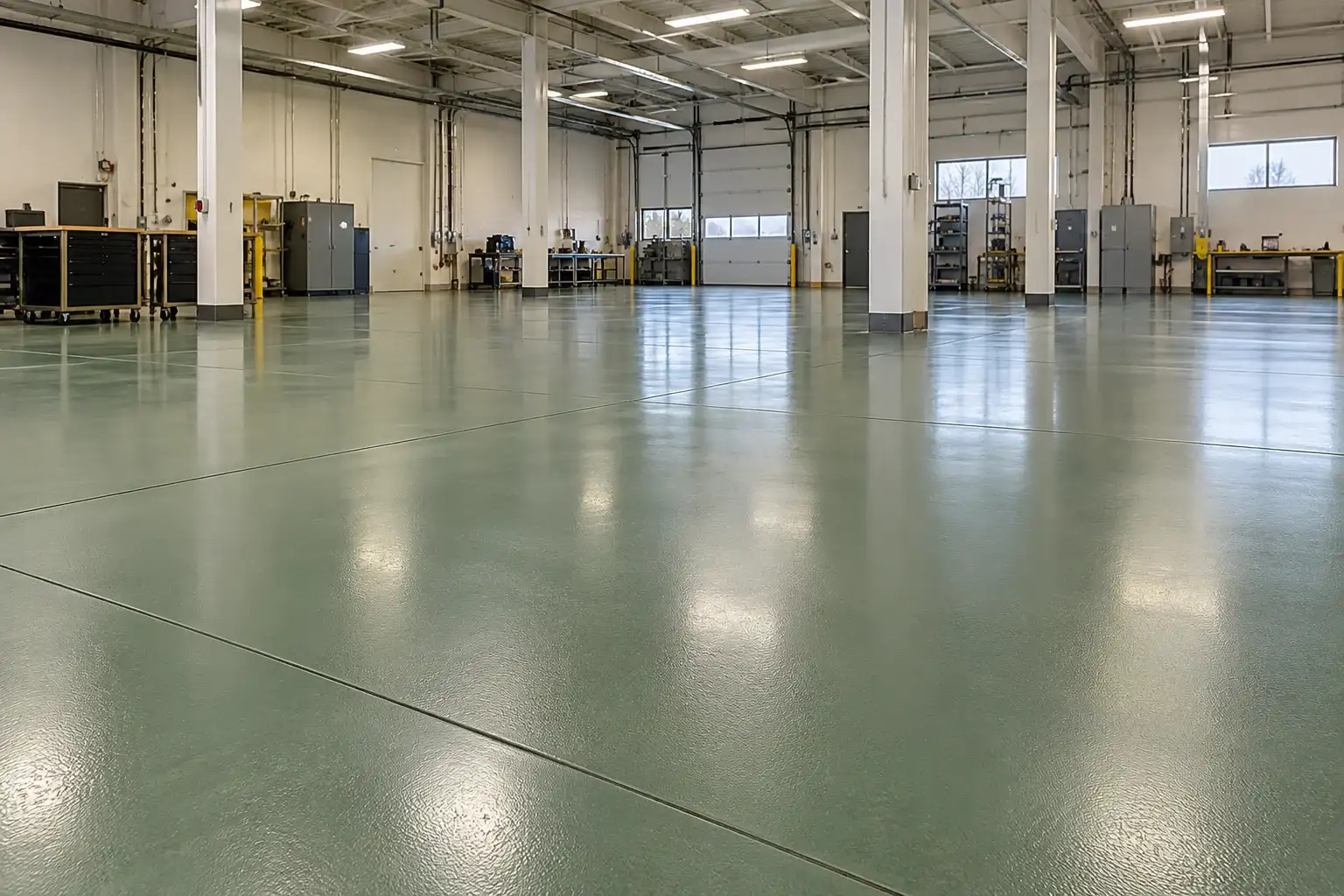
3 to 20 years, and where a floor lands on that range is largely set before the first coat goes down (HomeGuide (opens in a new tab)). A 20 to 30 mil flake build over a ground, tested slab can sit toward the top of the range. A 3 to 5 mil kit rolled over a dusty slab can sit at the bottom. 4 things move the number: film thickness, how the slab was prepped, the moisture reading, and how much sun and traffic the floor takes. A garage door that faces west adds UV to the list, and standard epoxy has no built-in UV protection (a garage floor coating company's guide). Polyurea is listed at 10 to 20+ years (HomeGuide (opens in a new tab)) for readers weighing a different chemistry. The garage floor page shows which builds carry which lifespan.
Systems
Epoxy or polyaspartic for a garage?
Polyaspartic costs more and cures faster, and it can be the better topcoat for a garage that sees sun and hot tires. It runs $5 to $12 per sq ft (HomeGuide (opens in a new tab)) or $5 to $10 (Fixr (opens in a new tab)), against $4 to $10 for epoxy (HomeGuide (opens in a new tab)). Polyaspartic is more flexible and more UV stable than standard epoxy, and some builds use an epoxy base with a polyaspartic topcoat (a garage floor coating company's guide). The schedule is the other difference: some polyaspartic stages can cure in as little as 20 to 60 minutes and one polyaspartic schedule puts vehicle traffic at 96 hours (a garage floor coating company's guide), while HomeGuide lists polyaspartic at 1 to 2 days to cure and epoxy at up to a week (HomeGuide (opens in a new tab)). For a working garage in Mesa, an epoxy base with a polyaspartic topcoat can be a build that handles July. For a shop with no daylight and no hot tires, solid epoxy does the job. The polyaspartic and epoxy page compares them side by side.
Systems
How thick should the coating be?
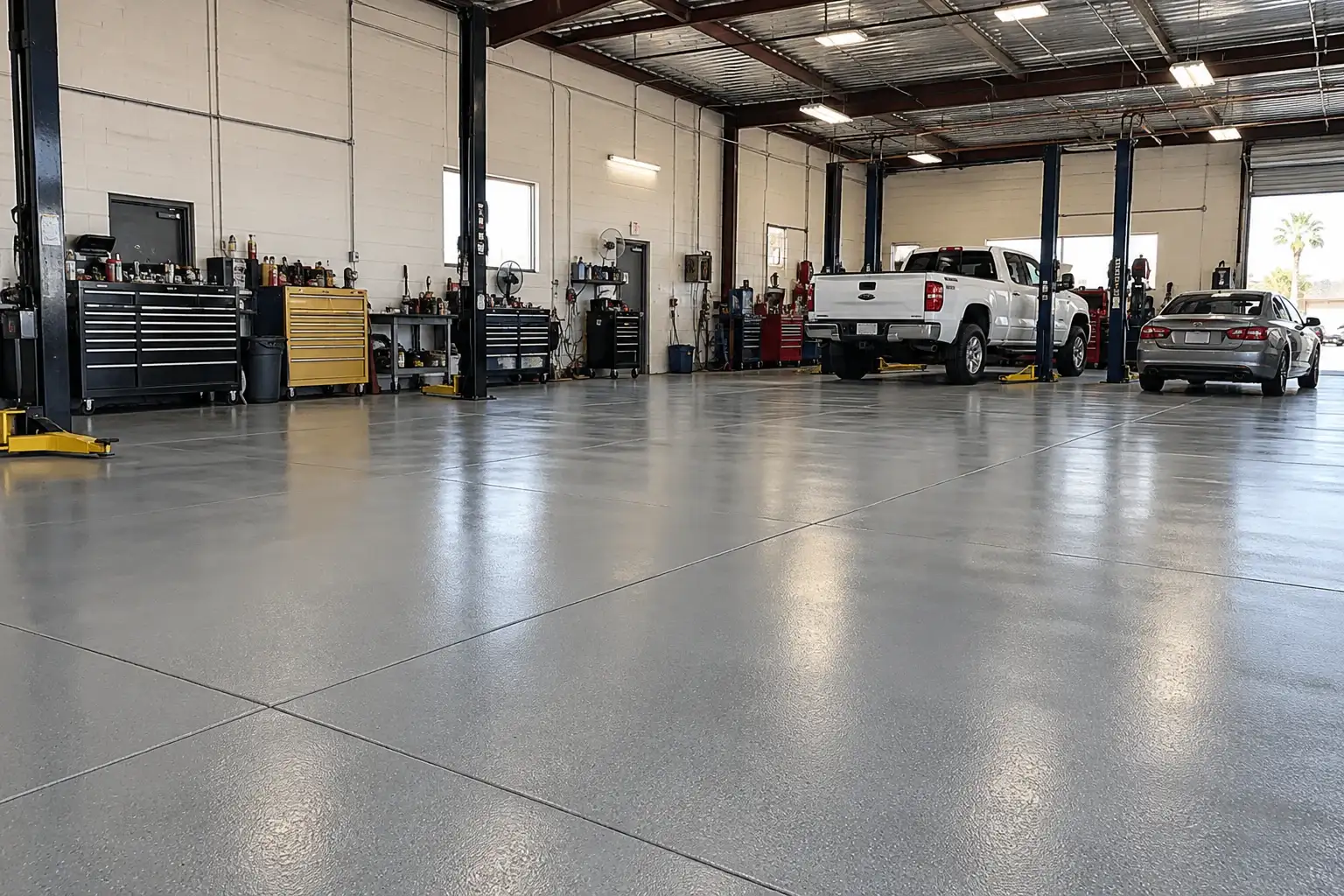
Thick enough for the traffic it takes. A garage floor wants 20 to 30 mil, a commercial kitchen or shop wants 40 to 60 mil of quartz, and a troweled industrial floor runs 60 to 250 mil (an epoxy flooring guide). Under that, a two-coat solid epoxy lands at 10 to 20 mil and a box-store kit at 3 to 5 mil. A polyaspartic topcoat adds 3 to 5 mil per coat, which is how a flake build gets its wear layer without a second full broadcast. Thickness is not a selling point on its own: a 60 mil floor over a slab that was never ground is a thick coating that can let go in one piece. What the number buys is abrasion life at the traffic lane and enough film to survive a hot tire. The garage page and the commercial page each set out the build for their traffic.
Signs
Why do hot tires lift a coating?
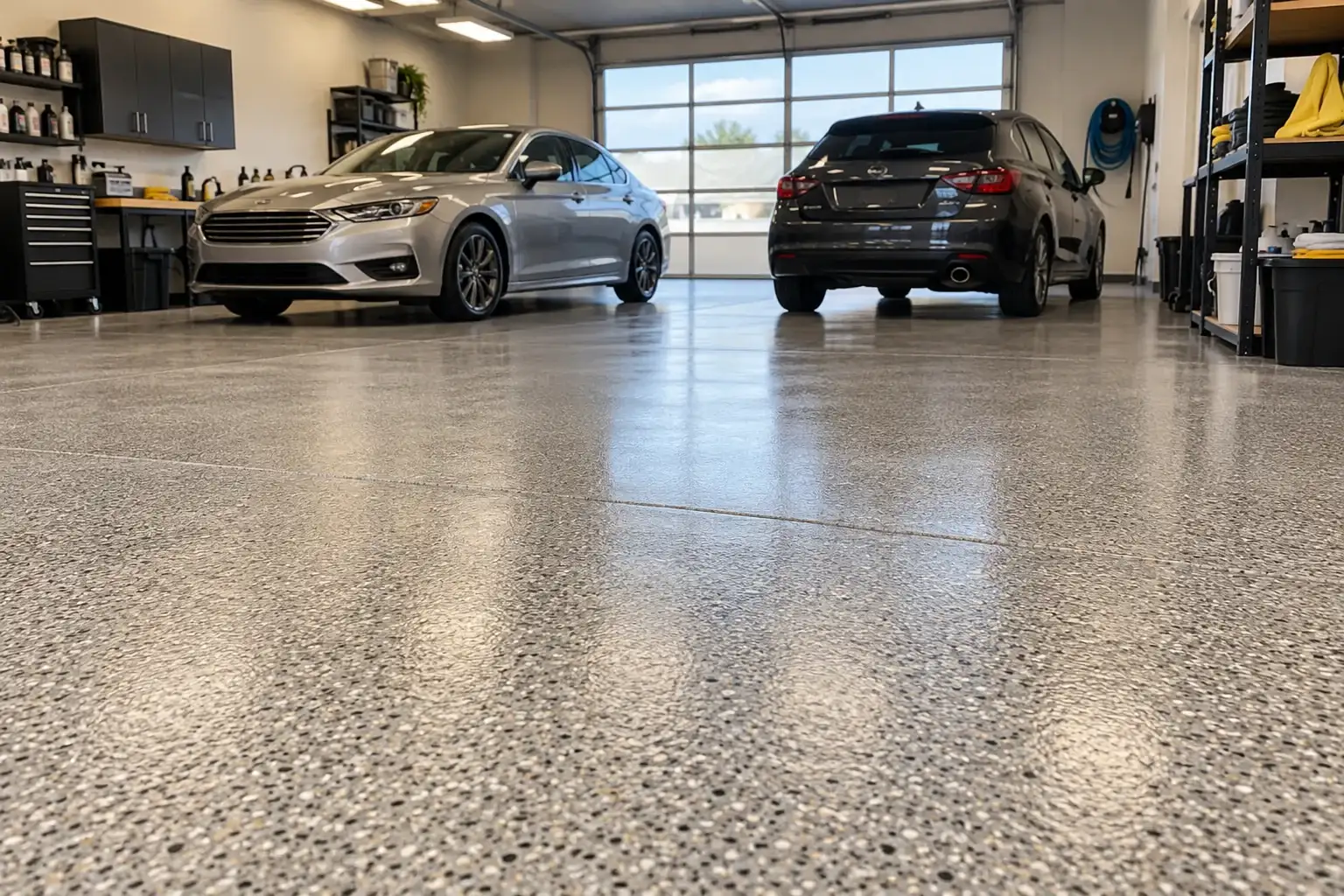
Because the tire is hotter than the coating was built to take. Tires can reach above 200 F after a drive, and that heat softens certain coatings enough for the rubber to bond with the surface (a garage floor coating company's guide). An epoxy trade guide names 3 causes: a product never rated for vehicle traffic, driving on it before the rated vehicle cure, and a bond that was marginal from the start, which covers acid etching instead of grinding, coating over a sealer or a curing compound, and a dusty slab (an epoxy trade guide). Pickup and stain are not the same failure. Pickup leaves bare concrete behind because the film left the slab. A stain is plasticizer and carbon pressed into the film, and the coating is still there. If the coating can still be felt across the mark, it is staining and the film is still attached. If the flake comes with it, the film let go. The garage floor page covers the vehicle-rated builds.
Moisture
Does the slab need a moisture test?
Yes. It is the smallest line on the job and the one that decides whether the floor stays down. The pass marks are under 75 percent relative humidity on an ASTM F2170 in-slab probe, or under 3 lb per 1,000 sq ft per 24 hours on ASTM F1869 (an epoxy flooring guide). Moisture is the leading cause of coating failure, and a film over damp concrete cannot fuse to the slab, so it bubbles or peels (a garage floor coating company's guide). A slab poured in 1998, a slab on a lot that takes irrigation runoff, and a new build with a curing compound on it all read differently on the same afternoon. The test is done before material is ordered, because a slab that reads high changes the build rather than the schedule. The concrete prep page covers testing and what follows a high reading.
Timeline
How long before a car parks on it?
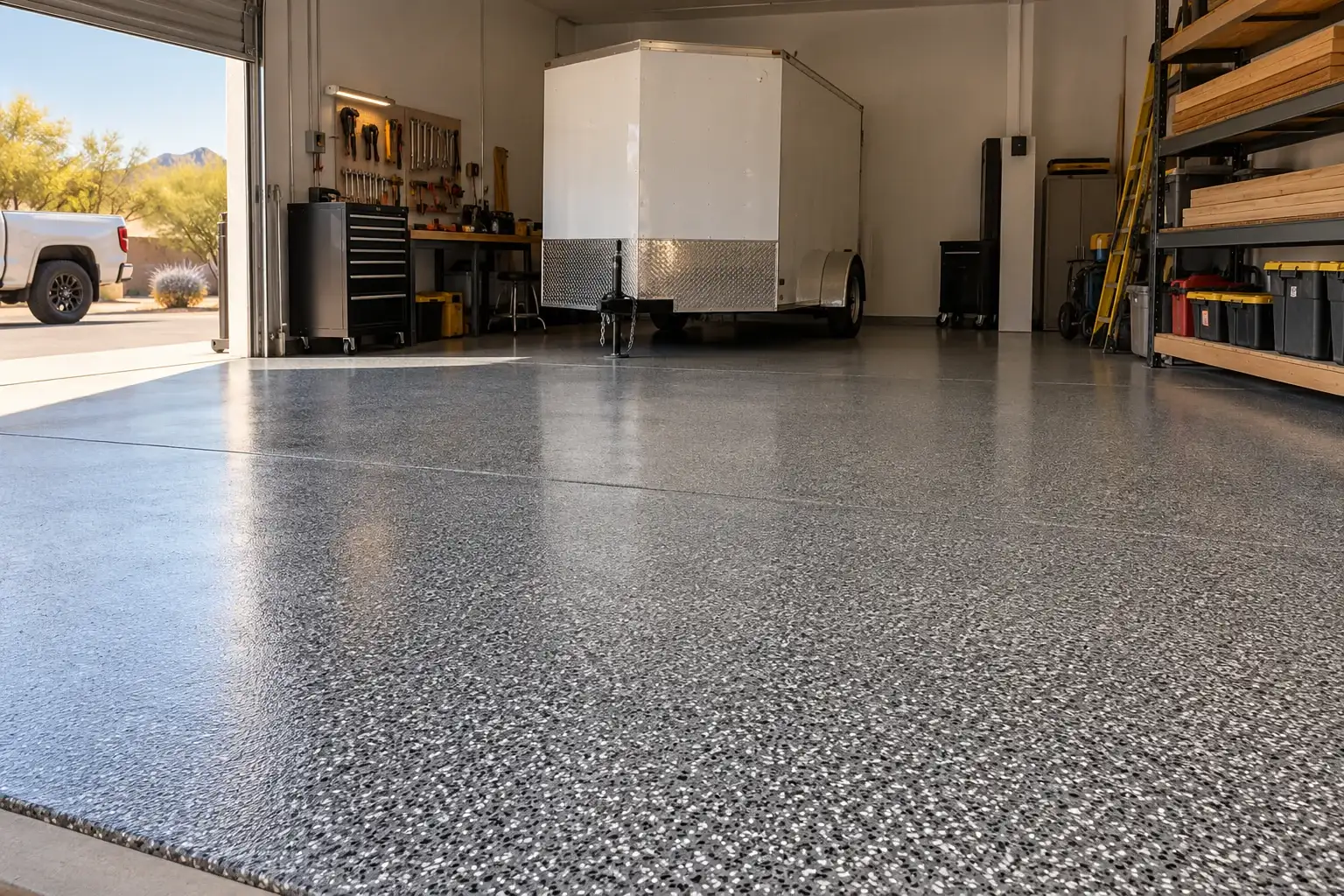
96 hours on one published polyaspartic schedule, and up to a week for a standard epoxy. On that schedule some stages can cure in as little as 20 to 60 minutes, and the floor takes light foot traffic at 12 hours, everyday use at 24 hours, garage contents at 48 hours, and vehicle traffic at 96 hours in warmer conditions (a garage floor coating company's guide). Epoxy can need up to 1 week to cure (HomeGuide (opens in a new tab)). The rated vehicle cure is not a suggestion. Driving on a floor before the rated vehicle cure is one of the 3 causes of hot tire pickup (an epoxy trade guide), and the damage can show up weeks later as a patch of bare concrete where the tire sat. Plan the job around the car, not the other way around: a car parked on the street for 4 days is cheaper than a floor that has to be stripped. The installation process lays out the days.
Timeline
Can it go down in an Arizona summer?
Yes, if the day is planned around the slab rather than the calendar. Epoxy coatings call for installation temperatures between 50 F and 90 F (a garage floor coating company's guide), and July normals in Mesa are a 106 F high and a 79 F low (NOAA NCEI (opens in a new tab)). That leaves a window from first light to mid morning, and the slab has to be checked with a gauge rather than a hand. A slab in the shade at 6 am and the same slab in the sun at 2 pm are 2 different jobs. Monsoon humidity is the second half of it: 1.18 in is the July normal (NOAA NCEI (opens in a new tab)), and a damp morning can push a moisture reading up. Summer work is possible. If the floor can wait, October through April is generally the milder window.
Moisture
Is epoxy slippery?
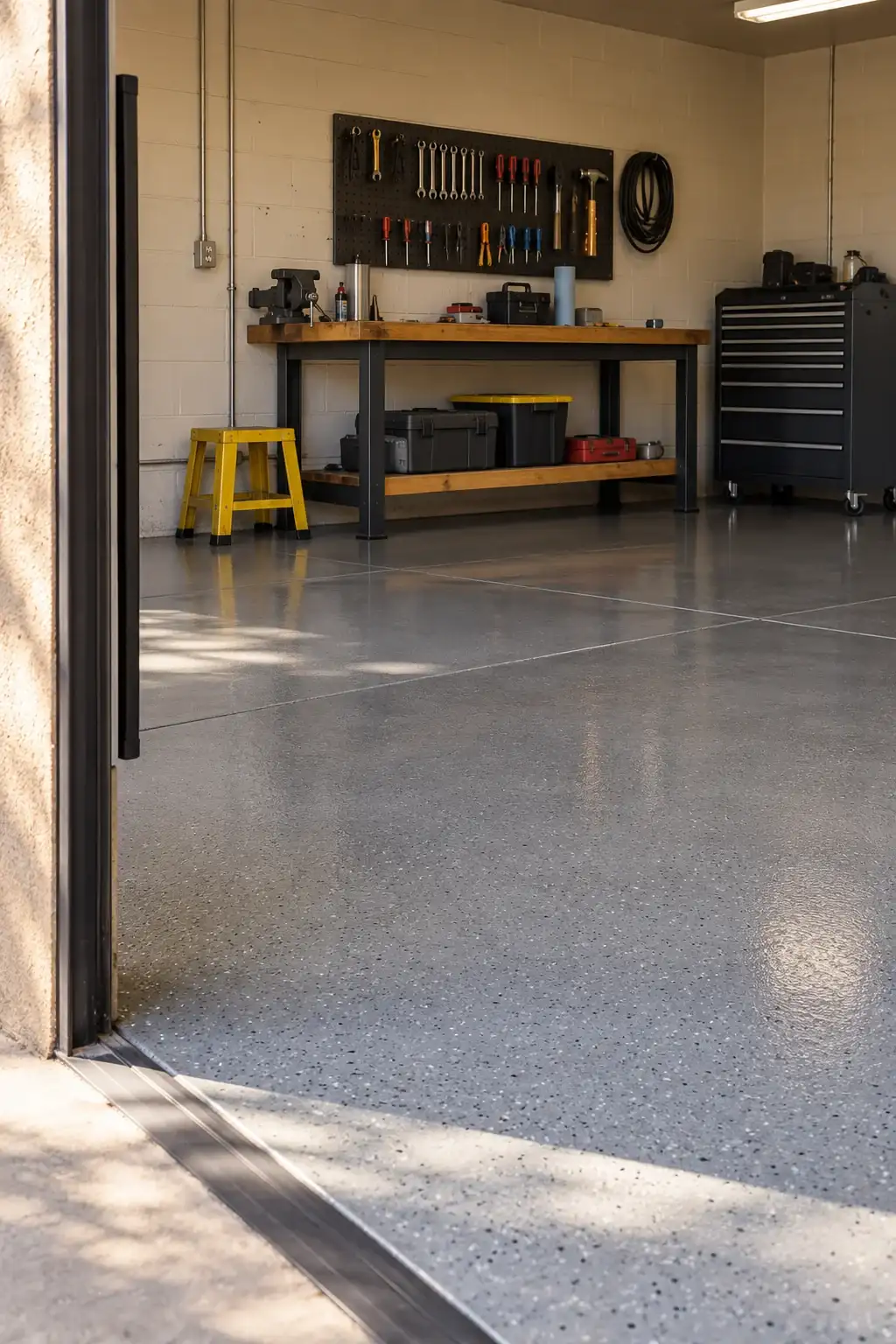
A smooth epoxy floor can be slippery when wet. The measure is the wet dynamic coefficient of friction, and ANSI/NFSI B101.3 is a test method for it on hard surface floors. What changes the number is texture in the film. A full flake broadcast at a 20 to 30 mil build puts a grit layer between the shoe and the resin. A metallic floor is a resin film with no grit in it, so it can read slicker under a wet shoe, and it is a poor fit for a threshold that takes rain. A quartz broadcast at 40 to 60 mil is what a commercial kitchen or a washdown bay uses. If slip is the concern, name it before the build is chosen.
Finishes
Flake or metallic?
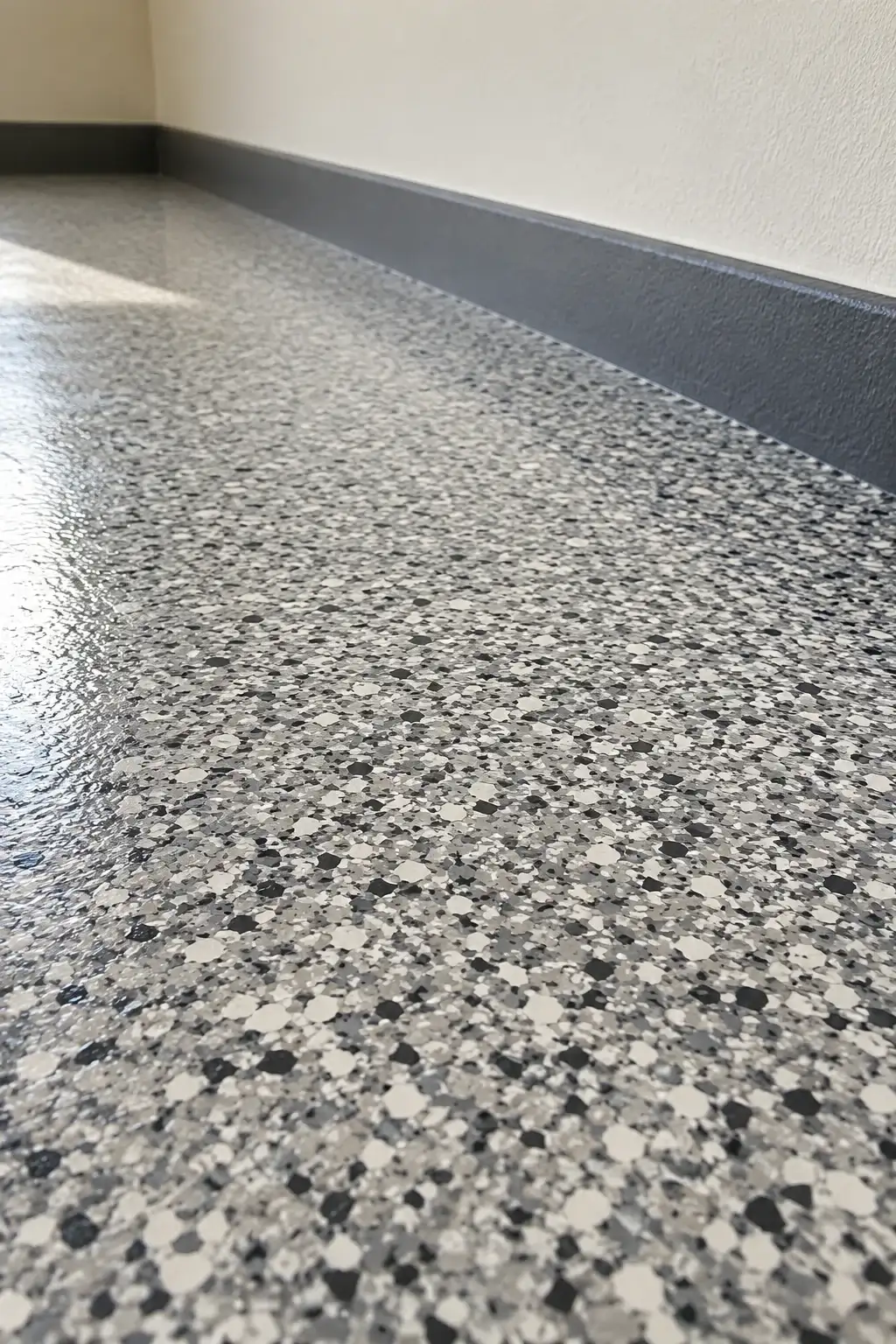
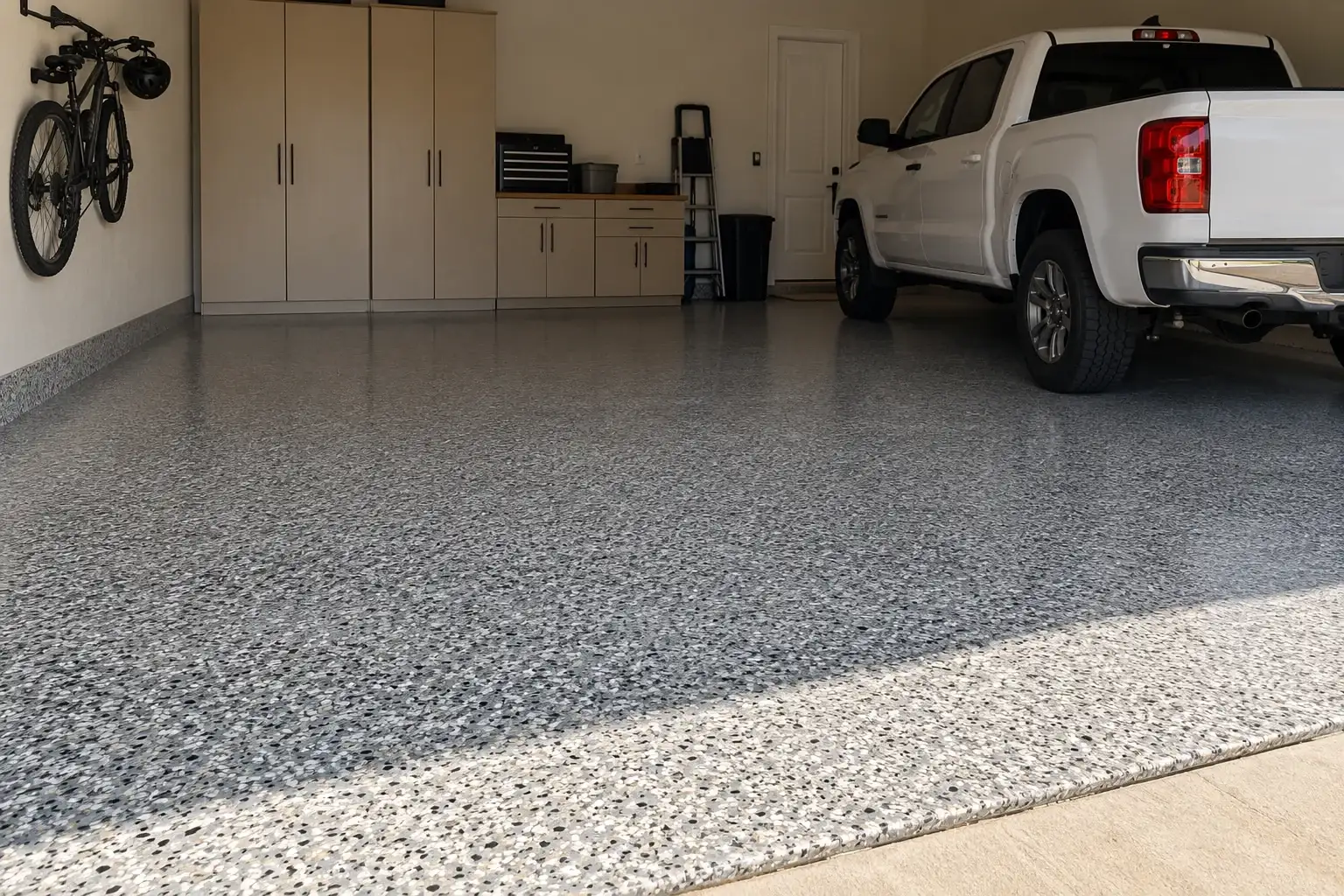
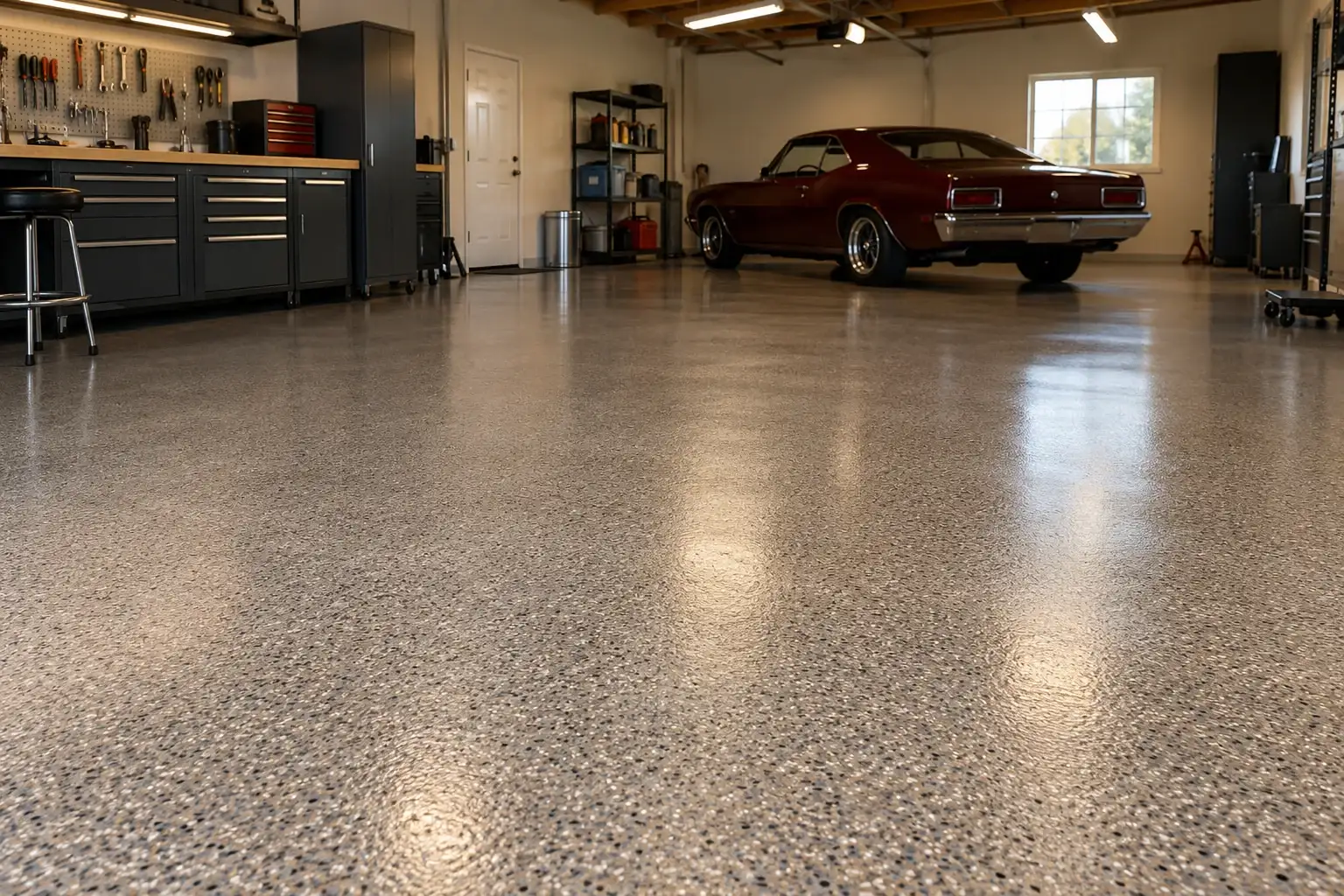
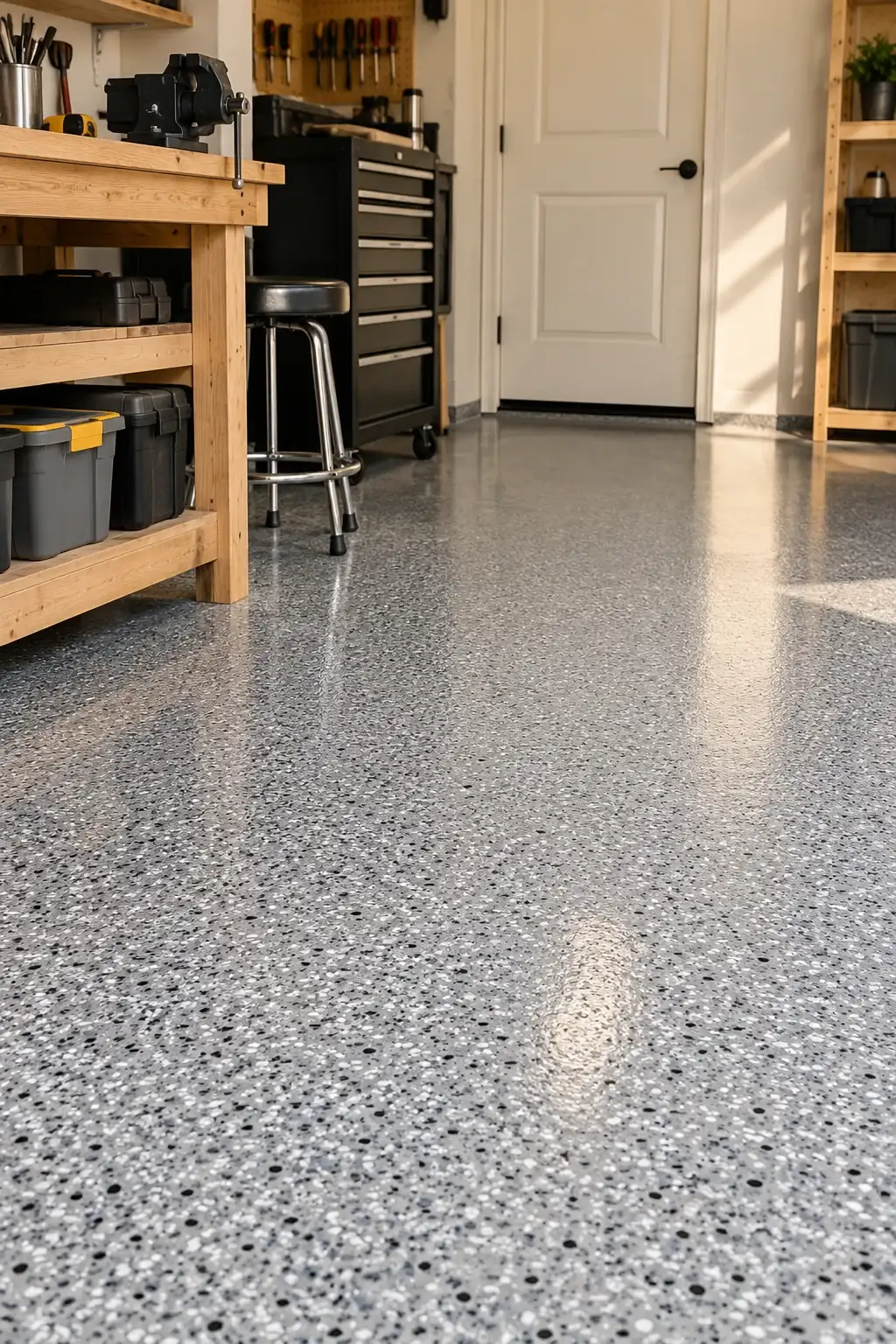
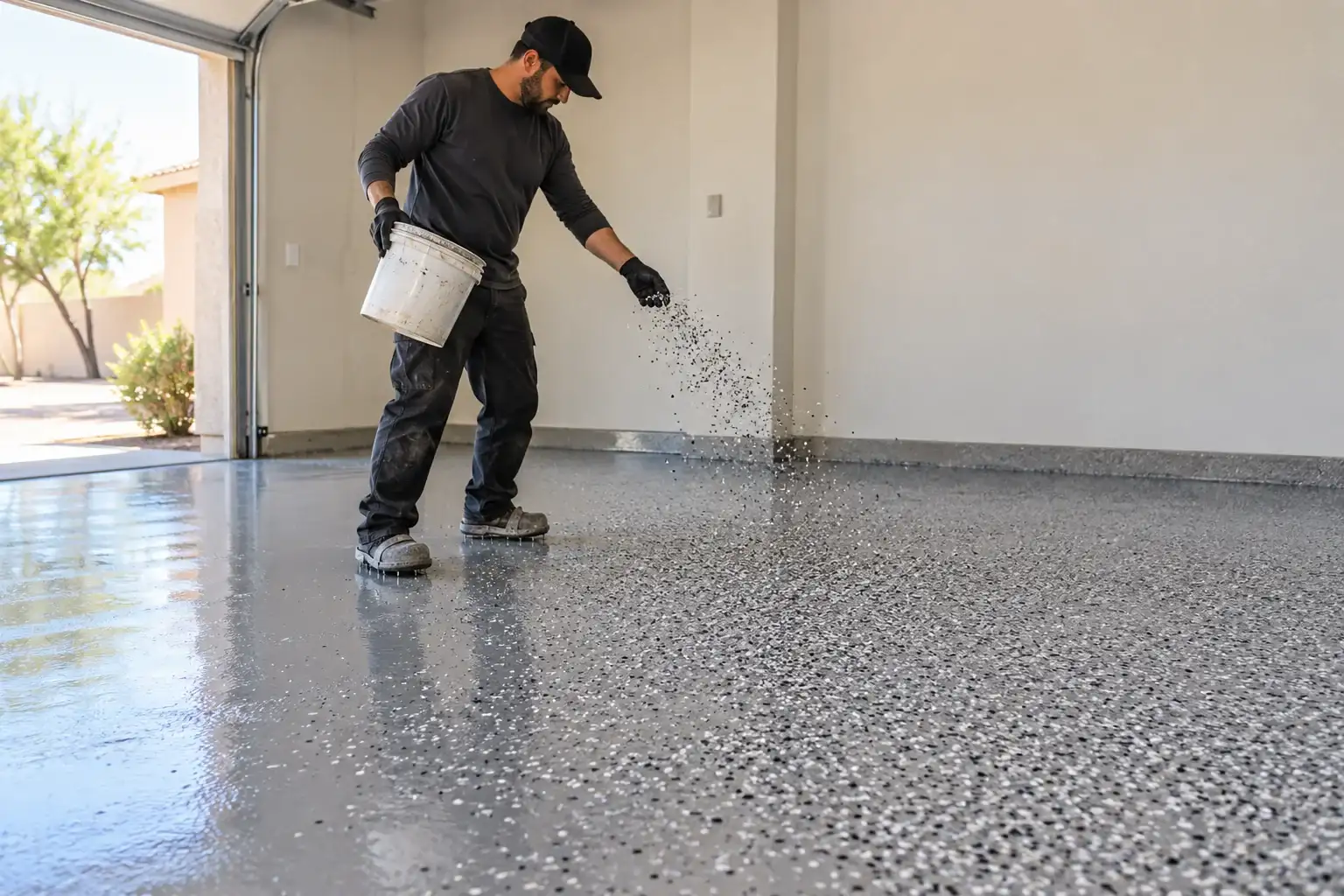
Flake if the slab is ordinary and the floor has to work, metallic if the slab is flat and the floor is on show. A full flake broadcast hides trowel marks, patches and the line where 2 pours met, and it carries a 20 to 30 mil build (an epoxy flooring guide) with texture underfoot. Metallic pigment flows in the resin, reflects light, and shows every imperfection the slab has, plus every lap in the pour. It also puts no grit in the film, so it can be the slicker of the two when wet. In a Mesa garage that takes grit, hot tires and a west door, flake is the build that holds its look. In a showroom, a patio or a hallway, metallic earns its cost. Both need the same ground slab and the same moisture reading. The residential page covers patios and garages.
Moisture
Solid epoxy or water-based kit?
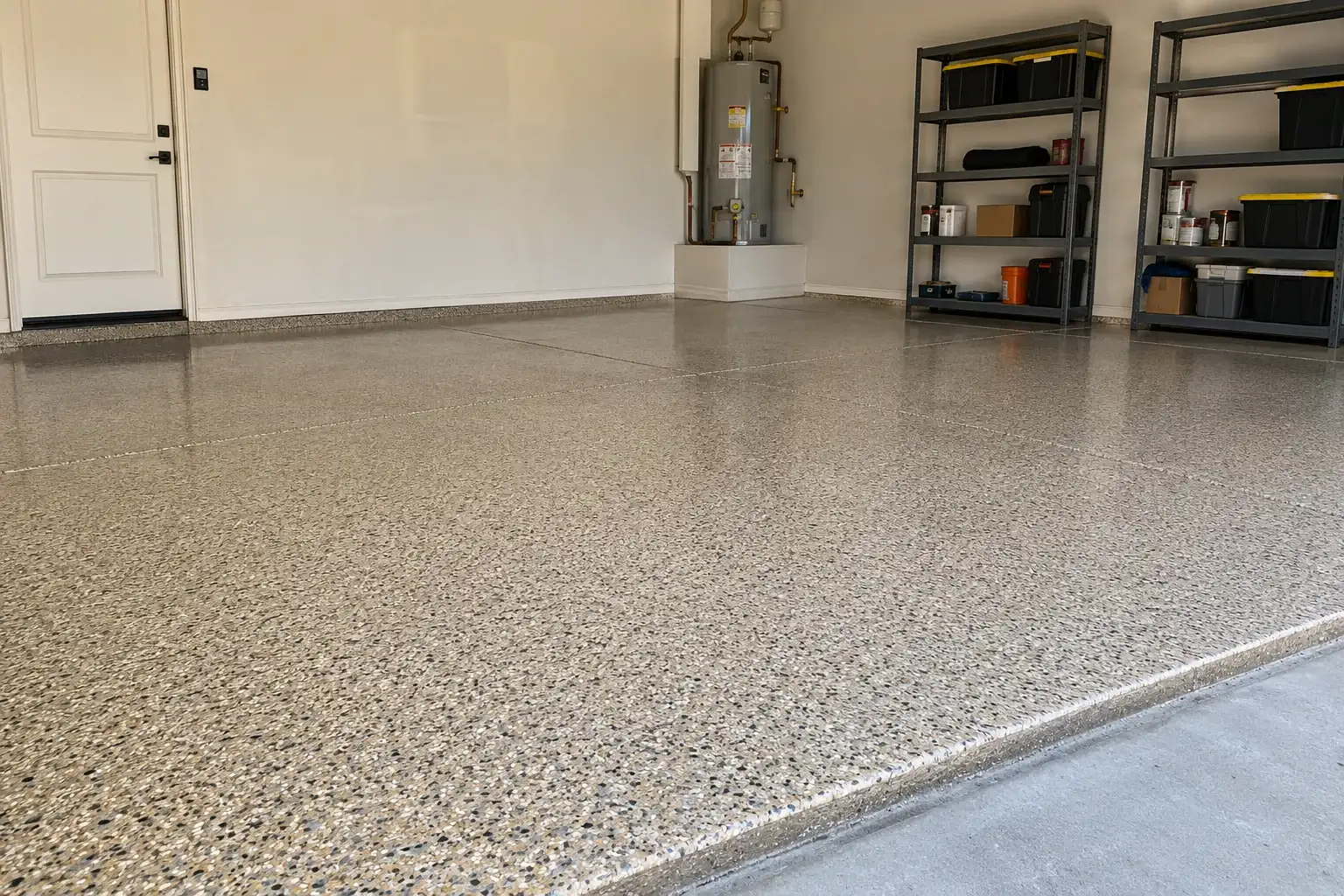
The kit is a sealer, not a floor. A box-store kit leaves 3 to 5 mil of dry film, against 10 to 20 mil for a two-coat solid epoxy and 20 to 30 mil for a flake garage build (an epoxy flooring guide). At 3 to 5 mil there is almost nothing between the tire and the concrete, so the traffic lane goes first, and when the color goes the slab is bare. Volume solids explain the rest: dry film equals wet film times volume solids, so a 50 percent solids coating rolled at 6 wet mils leaves 3 dry mils, and the wet number on the pail is not the floor. A kit is fine for a shed or a rental patio that nobody drives on. For a garage, material runs $1 to $5 per sq ft against $3 to $5 for labor (HomeGuide (opens in a new tab)), and the cheap build can be the one that gets done twice. The garage page names the builds.
The slab
Grinding or acid etching?
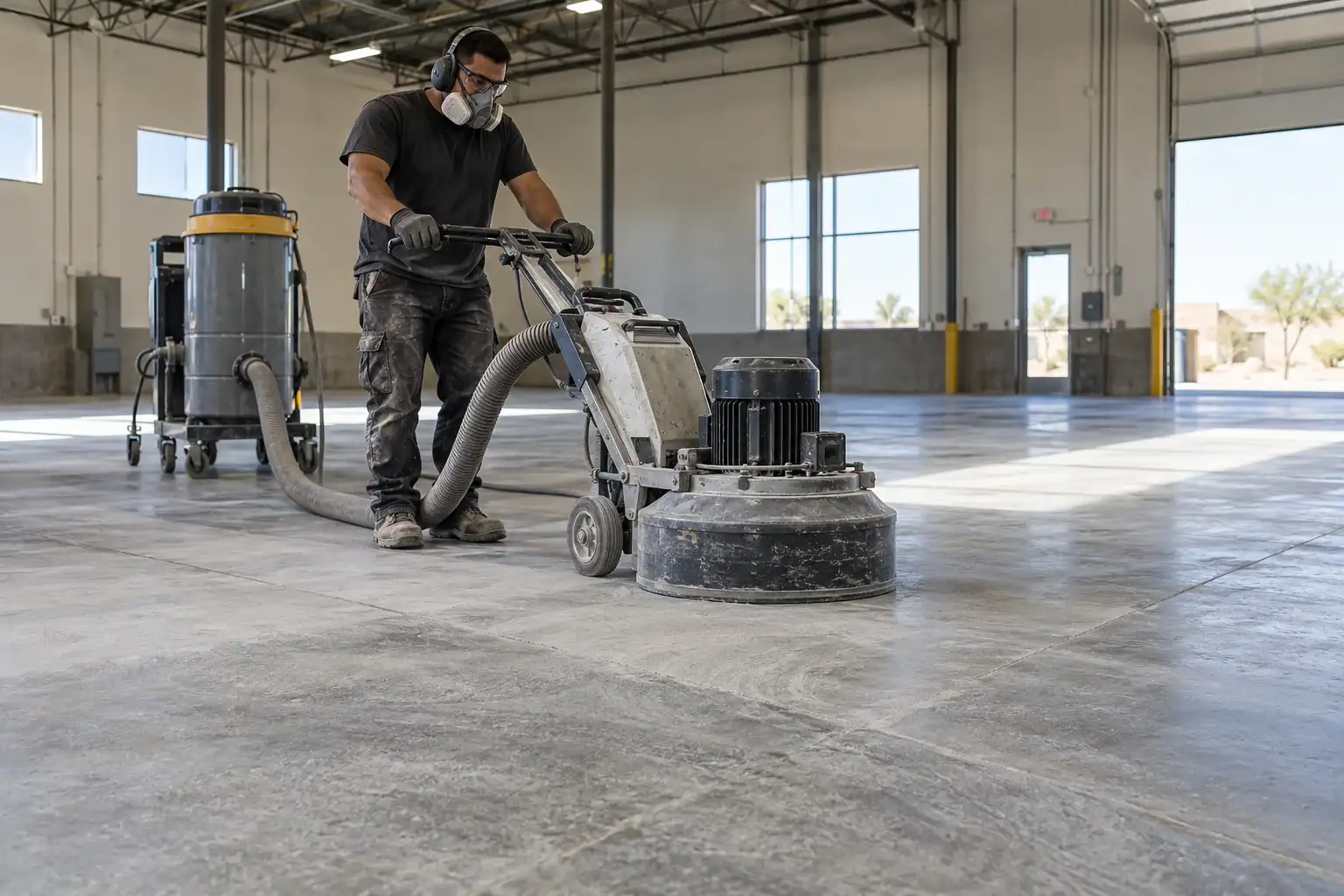
Grinding. Acid etching shows up on the list of reasons a coating lets go, and an epoxy trade guide lists it as an example of a bond that was marginal from the start. An etch can leave residue in the surface and may not remove a sealer or a curing compound, which an older slab can have on it. A diamond grind opens the concrete and leaves a profile the resin can key into, and it also shows the cracks, the high spots and the oil patches before the coating hides them. That is the part of the job that decides the rest. A kit that says to etch and rinse is asking the concrete to hold a film it was never opened for. The concrete prep page covers grinding, crack filling and what a slab needs before a broadcast.
The slab
Can it cover cracks?
Yes, cracks get opened, cleaned and filled before the base coat, and a filled crack still shows a line when the light hits it. A crack that is still moving will telegraph through a rigid fill, so the fill buys a flat surface and a coating that stays continuous, not a slab that stops moving. Concrete expands in summer heat and contracts when it cools (a garage floor coating company's guide), and a Mesa slab does that every year. A structural crack, a settled panel, or a crack with a height difference across it is a slab repair before it is a coating job. Cosmetic cracks are the common case, and a full flake broadcast hides the repair better than a solid color does. The prep page covers crack repair and patching.
The slab
Can it cover oil stains?
Not on its own. Oil has to come out of the slab before anything goes over it, or the film can let go over the stain. Oil that has soaked in sits between the resin and the concrete, and a coating does not bond through it. The work is degrease, grind, and repeat, and if the oil is deep the patch gets cut out and filled. A dark mark left by a tire is a different thing: that is plasticizer and carbon in the film, and the coating is still there (an epoxy trade guide). One is a mark in the film, the other means the slab under it is contaminated. A garage with one parking spot that has held a leaking car is the usual case, and it is worth finding before the material is ordered. The concrete prep page covers degreasing and patching.
Sun and heat
Does epoxy yellow in the sun?
Yes. Standard epoxy has no built-in UV protection and visibly discolors in sun (a garage floor coating company's guide). What holds color is a UV-stable topcoat, which is why a garage with a west-facing door gets a polyaspartic topcoat over the epoxy base, and why a shop with no daylight can live with epoxy alone. Mesa makes this a real decision rather than a technicality: July normals run to 106 F (NOAA NCEI (opens in a new tab)), and a west wall radiates into the evening long after the air has cooled. Yellowing is a color change, not a failure. The film is still attached, the flake is still covered, and the floor still works. It matters at resale and it matters on a light gray floor, where the shift is easiest to see. The polyaspartic page covers the topcoat options.
The slab
Can it go on new concrete?
Yes, once the slab is dry enough to test, not once the calendar says it is ready. New concrete carries water and often a curing compound, and a coating over a curing compound is one of the marginal bonds an epoxy trade guide lists. The test comes first: under 75 percent relative humidity on an ASTM F2170 probe, or under 3 lb per 1,000 sq ft per 24 hours on ASTM F1869 (an epoxy flooring guide). Grinding takes the curing compound and the weak top layer off before anything else happens. A new slab also moves through its first summer, since concrete expands in heat and contracts when it cools (a garage floor coating company's guide), so the first 12 months are the ones to watch. A new build is the case where the test matters most, because the slab looks perfect and can still read wet. Contact with the pour date and the square footage and we call you back. The prep page covers the sequence.
Good to know
How do you clean it?
Sweep or dust mop first, then a damp mop with a neutral cleaner, and no acid. Grit is what wears a coating, and sweeping is the habit that keeps texture in the film. A soft mop and clean water are enough for a garage. Brake fluid, paint thinner and battery acid get wiped up rather than left to sit, because solvents can soften the film. A steam mop and an abrasive pad are the 2 things to keep off a glossy floor, and a metallic finish shows the mark from either one. Twice a year, look at the traffic lane by the door. That is where a recoat starts, and catching it early can be the difference between a topcoat and a rebuild.
Systems
When does a floor need recoating?
When the topcoat is worn through at the traffic lane and the color has gone chalky, not when a calendar says 10 years. Epoxy is listed at 3 to 20 years (HomeGuide (opens in a new tab)), which is a range wide enough that the floor in front of you is the only useful measure. The signals: the flake showing through at the door, a wear lane where the gloss has gone flat, hot tire marks that no longer wipe off, and a color that has shifted toward yellow. A recoat is a screen and a fresh topcoat, and a polyaspartic topcoat adds 3 to 5 mil per coat (an epoxy flooring guide), which puts a wear layer back on a film that is still attached. Lifting, bubbling or a hollow sound underfoot is not a recoat. That is a strip and a new build. The polyaspartic page covers the topcoat.
Costs
What does a commercial floor cost?
The closest published figures are national, and a shop floor is priced by square footage and build rather than by the bay. A concrete floor coating of any kind runs $1,250 to $4,000, average $3,000 (Fixr (opens in a new tab)), Fixr puts thick coat epoxy at $10 to $15 per sq ft installed (Fixr (opens in a new tab)), an epoxy flooring guide puts professional systems at $3 to $15 for 2026, and HomeGuide puts all garage floor coating types at $4 to $12 per sq ft, or $1,600 to $6,900 for a 2-car (HomeGuide (opens in a new tab)). A commercial build is 40 to 60 mil of quartz instead of 20 to 30 mil of flake, and drains, coving and thresholds are part of the job, so a commercial number tends to sit toward the top of those ranges. Published ranges, not a quote. The commercial page and the cost page break it down.
Systems
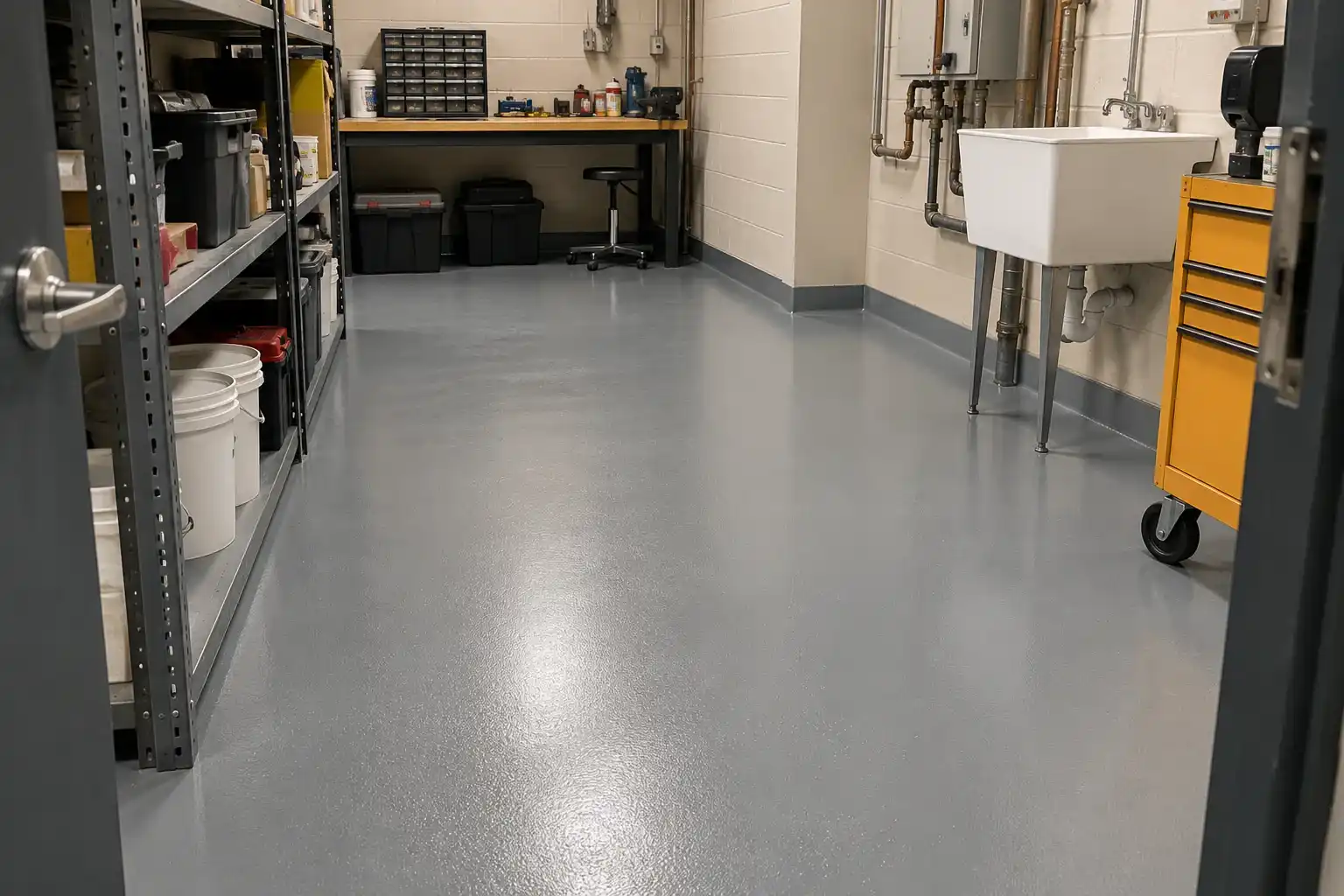
Do shops and restaurants need a different build?
Yes. A shop floor starts at 40 to 60 mil of quartz and a heavy plant floor goes to 60 to 250 mil troweled (an epoxy flooring guide), well past the 20 to 30 mil a garage gets. The difference is load and chemistry. A restaurant kitchen carries grease, hot water and a drain, and the drain ring and the cove base can be where a kitchen floor gives out first. A shop carries steel wheels, dropped tools and solvents, and it wants a quartz broadcast for abrasion rather than a decorative flake. Both need a moisture reading before the build is chosen. A floor that is specified like a garage and used like a kitchen can fail early, and the cost to fix it is a strip, not a topcoat. The commercial page and the industrial page cover both.