Service 04 of 06 · Mesa, AZ
Mesa residential epoxy flooring company
You want the patio, the laundry room and the workshop to stop being bare concrete, without a coating that chalks out after one Mesa summer. Send the room and the square footage, and someone from our team calls you back to go over the options.
What you get
Rooms that stop looking unfinished
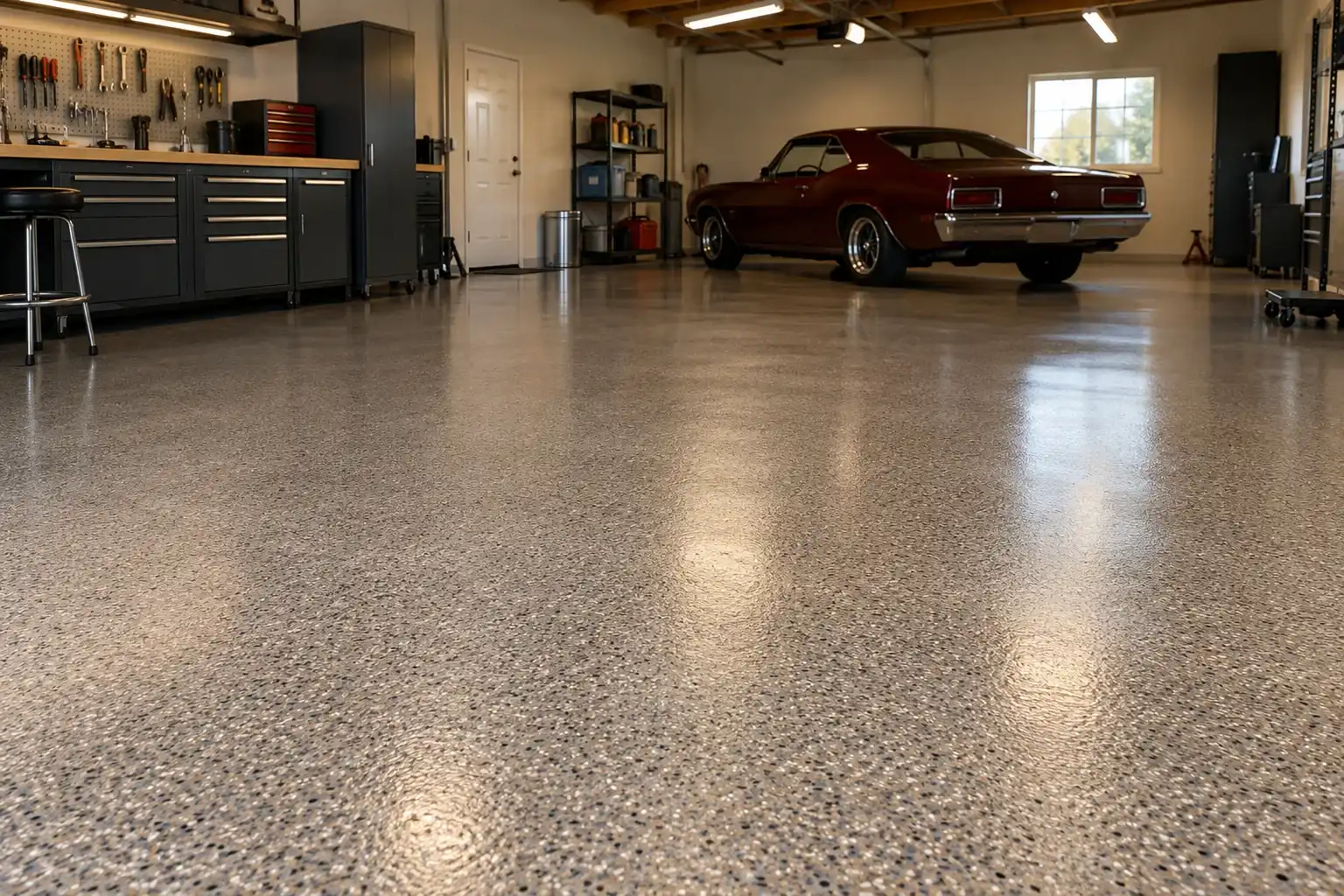
Residential epoxy flooring in Mesa covers more ground than a garage bay. A patio off the back slider, a laundry room that takes lint and the odd overflow, a workshop bench area, a casita and an interior concrete floor all take the same family of coatings, sized to the traffic and the sun that room gets. The material question is the easy one. Sun and temperature affect whether the floor still looks right years later.
- A surface that wipes clean in a laundry room, instead of concrete that holds lint and soap scum in its pores.
- Grit worked into the topcoat on a patio, so wet feet in July are not a slip test.
- A UV-stable topcoat over the color, which is the part of the build that holds the color on a sun-facing floor.
- A build sized to the room, from a light 2-coat in a workshop to a full flake in a casita.
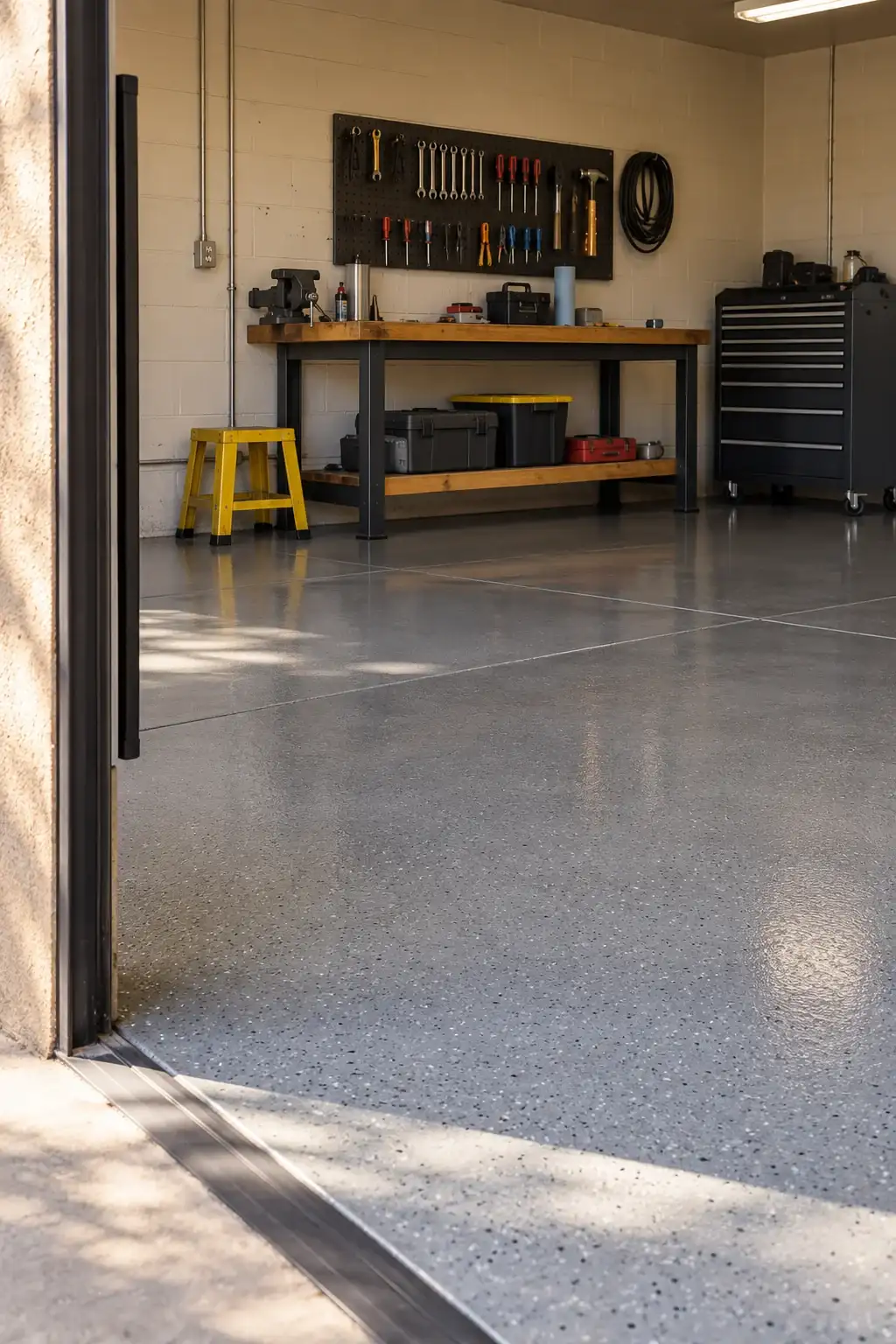
- A cove at the wall base and trim at the door, so a mop finishes the edge instead of a brush.
Signs
5 signs the coating on your concrete is done
The surface chalks when you rub it
A white powder on your hand can mean the film is breaking down at the top, and a fresh topcoat can be the fix while the color underneath is still there.
The color has gone flat or shifted where the sun lands
Epoxy has no built-in UV protection and visibly discolors in sun, and a UV-stable topcoat is what holds color, per a garage flooring guide. A west-facing patio is a likely place to see it first.
Hairline cracks have opened across the slab
A slab moves with the seasons, and a crack that has widened past a hairline needs a fill that can move with it, not paint over it.
The patio holds water in a ring around the drain
Ponding means the slab lost its fall, and a coating follows the low spot rather than fixing it. Water that sits is water working at the edge of the film.
The patch at the step has come loose at the nose
Steps and thresholds take a lot of impact in the house, and a patch that lifts at the nose is a trip edge as well as a coating failure.
3 steps
How a room gets done
Step 1: The slab and the sun path come first
The moisture reading, any existing coating, the cracks and the hours of direct sun the room gets all go on paper before a color is chosen, because a west-facing patio and a north-facing laundry room do not take the same topcoat.
Step 2: The room gets ground, filled and masked
Diamond grinding opens the concrete, cracks and the failed step patch get filled, and cabinets, baseboards and the door threshold get masked before anything is mixed.
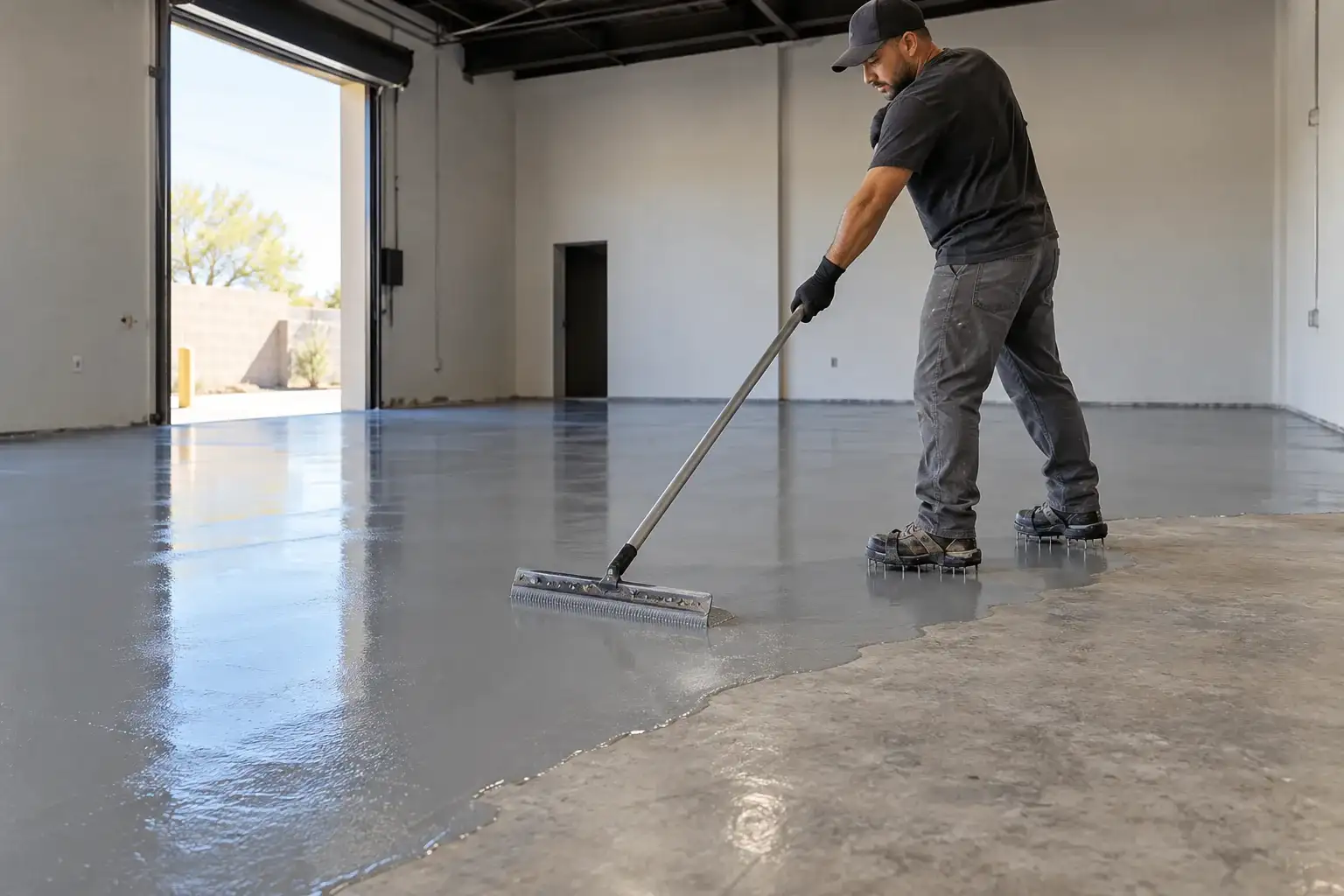
Step 3: The base and the color go down, then the room stays empty
The base coat goes down, the flake or the solid color goes into it while it is still open, and the topcoat follows once the base has set. Call (747) 243-2089 with the room, and we call you back with the days it needs.
Costs
What residential epoxy costs by room
A house floor is priced after someone sees the room, because a 200 sq ft laundry room with a failed patch and a 400 sq ft patio under full sun are not the same job. The published totals still give you a bracket. HomeGuide (opens in a new tab) puts a patio at $800 to $4,000, a kitchen floor at $400 to $2,000 and a basement at $1,200 to $20,000, which is the spread between a small utility room and a whole footprint.
| Room | Published range | Source |
|---|---|---|
| Patio | $800 to $4,000 | HomeGuide (opens in a new tab) |
| Kitchen floor | $400 to $2,000 | HomeGuide (opens in a new tab) |
| Basement | $1,200 to $20,000 | HomeGuide (opens in a new tab) |
| Any room, per square foot | $4 to $10 per sq ft | HomeGuide (opens in a new tab) |
Published ranges, not a quote.
The square foot number is the one that travels between rooms, and it is the reason to measure before you call. A patio priced at the top of its range can carry repair, a flake broadcast and a UV topcoat. The same square footage in a laundry room can carry less material and fewer hours. On HomeGuide's table every room works out to about $4 to $10 per sq ft, so the room total follows the square footage more than the room.
Sun and heat
The sun is what separates a patio from a garage floor
A garage bay spends most of its life in shade, and a patio does not. Epoxy has no UV protection built into it and will visibly discolor under direct sun, so the topcoat is what carries the color outdoors, per a garage flooring guide. That is the reason a patio specification reads differently from an interior one, and the reason a patio coating that skipped the UV layer can go chalky and pale while the floor under a carport still looks new. Polyaspartic topcoats are the more UV stable of the two chemistries, per a garage flooring guide, and some builds pair an epoxy base with a polyaspartic top.
Timeline
50 F to 90 F, and why a Mesa summer job starts at dawn
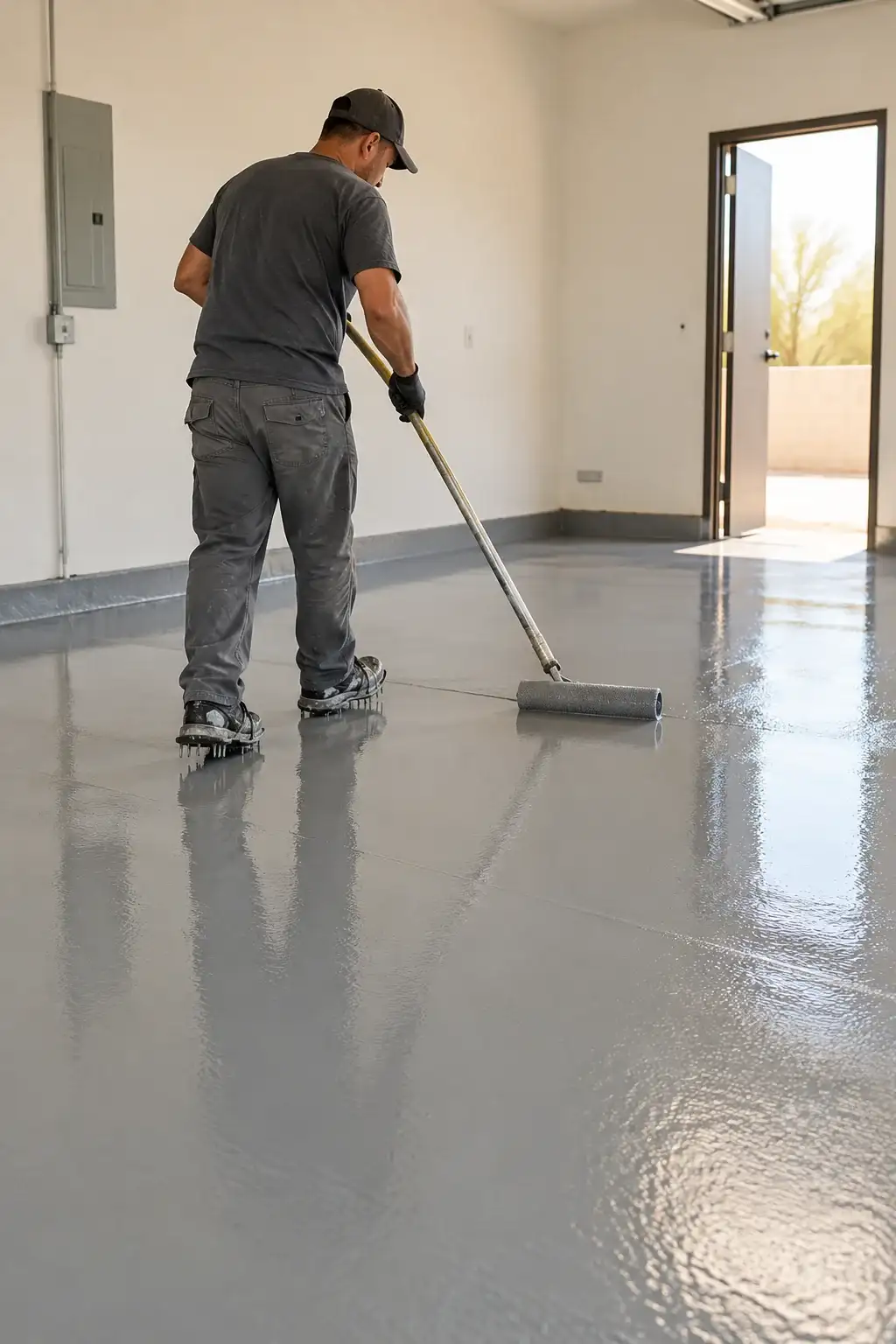
Epoxy needs the air and the slab between 50 F and 90 F to cure properly, per a garage flooring guide. Mesa sits above the top of that window for months of the year. The July normal high is 106 F with a normal low of 79 F, on 1.18 in of normal precipitation (NOAA NCEI 1991-2020 normals, station USC00022782), which means a July slab in direct sun can pass 90 F well before lunch. A summer job starts at first light for a reason: the base goes down while the slab is still inside the range, and the door stays shut through the afternoon. A winter job has the opposite constraint, because a cold snap can hold a garage slab under 50 F and stall the cure.
Moisture
A wet patio needs grip, not just color
Color is what gets picked first and grip is what gets noticed first. ANSI/NFSI B101.3 measures the wet dynamic coefficient of friction, and 0.42 is the minimum value a coatings manufacturer's technical note recommends a specifier use for a walking surface. A glossy patio with no grit in the coat can read well under that number when it is wet, and a pool deck or a patio that gets hosed down is where it can show up as a fall rather than a complaint.
5 questions
Questions people ask
Still have a question? Call (747) 243-2089 and describe the floor.
Will the color fade on a west-facing patio?
The epoxy under it can, because the resin has no UV protection of its own. A UV-stable topcoat is the layer that holds the color, and a polyaspartic top is the more UV stable choice for a surface in full afternoon sun, per a garage flooring guide.
Can a new coating go over the old one?
Only if the old film is sound, and that gets decided with a test patch rather than a guess. A coating that is chalky, lifting at an edge or sitting over a sealer has to come off down to concrete first, otherwise the new layer inherits the same failure.
How hot is too hot to coat a floor?
90 F for both the air and the slab, per a garage flooring guide. In June, July and August that means an early start and a closed door by mid-morning. A garage with a west-facing door can be the hardest of them, because the slab can keep radiating after the air has cooled.
When can the washer and dryer go back in?
In warm conditions a garage flooring guide puts a polyaspartic system at walkable in 12 hours, ready for daily use at 24 and clear for contents at 48. An epoxy-only build runs longer: HomeGuide (opens in a new tab) lists solid epoxy as walk-on dry in 18 hours and fully cured in 7 days, so a laundry room is worth planning around several empty days.
Is a coated patio slippery when it rains?
It can be, and that is a specification choice rather than a property of epoxy. Grit broadcast into the topcoat can raise the wet friction number, and 0.42 under ANSI/NFSI B101.3 is the figure a coatings manufacturer's technical note recommends a specifier use.
Keep reading
Related
- Garage floor epoxy: for the bay, with flake and solid systems.
- Polyaspartic and epoxy: for the UV and cure trade-offs in one place.
- Concrete prep and coatings: for grinding, patching and moisture testing.
- Epoxy flooring cost: for every published range, by system and by room.
- The Mesa epoxy guide: for the full walk-through on systems, testing and cure.
- Tempe patios and rentals: and Fountain Hills casitas for the nearby slab notes.
- Commercial Epoxy Flooring: Commercial epoxy flooring in Mesa gets specified around 2 questions: what rolls across the slab, and what gets spilled on it.
- Industrial Epoxy Flooring: Call (747) 243-2089
- How an install runs
- Floor looks
- Areas around Mesa