Process · Mesa, AZ
Mesa epoxy flooring company: how an install runs
5 stages sit between the first call and the morning a car parks on a finished epoxy floor in Mesa, and one cure clock decides the date. Call (747) 243-2089 and we call you back with the 4 questions that start it.
Services
How many days the garage is out of service
The coating goes down faster than the cure lets you use it. A garage floor coating company's guide lays out the return to service for its polyaspartic system in 4 steps, in warmer conditions, and each step lands on a different day:
- 12 hours for light foot traffic.
- 24 hours for everyday use.
- 48 hours before the contents go back in.
- 96 hours before a vehicle parks on it.
A 2-car floor that takes 2 days of work is about a 6 day event when you count from the morning of the grind to the morning the car comes home. If the bay is the only parking you have, book the week around the cure rather than around the install.
The rest of the schedule is built backwards from that clock.
Contact
Stage 1: the call, and the 4 answers that set the job
Nothing gets scheduled before 4 questions have answers, because each one changes the system, the build or the number of days on site.
- Square footage. A garage floor runs 288 to 864 sq ft across 1, 2 and 3-car bays, per HomeGuide (opens in a new tab), and the footage sets the material volume and the hours.
- What parks or runs on it. A daily driver, a boat trailer, a lift, a pallet jack and a home gym are 5 different floors. Vehicle traffic sets the build and the cure clock.
- Drainage. Where the water goes when the floor gets hosed out, whether there is a floor drain, and which way the slab falls. A coating cannot fix a slab that drains into a wall.
- What is on the slab now. Bare concrete, a sealer, paint, carpet glue, a failed box-store kit or 20 years of oil. Each one changes the prep, and prep is a large share of the labor.
Those 4 answers usually name the system and hold a window. They are also why a number before them stays a rough range.
Moisture
Stage 2: the moisture test, and the prep plan behind it
Concrete pulls moisture up from below, and a film laid over damp concrete blisters or peels instead of holding. A garage floor coating company's guide calls moisture the leading cause of coating failure, which is why the test comes before the plan and not after the price.
The thresholds: under 75 percent relative humidity on an in-slab probe run to ASTM F2170, or under 3 lb per 1,000 sq ft per 24 hours on the ASTM F1869 sheet test, both as published in an epoxy flooring guide.
A slab that reads over either number gets a mitigation coat before anything else goes down. That is an added product and added time, and it is better found now than after a floor lifts.
The slab
Stage 3: grind, cracks, spalls and the oil
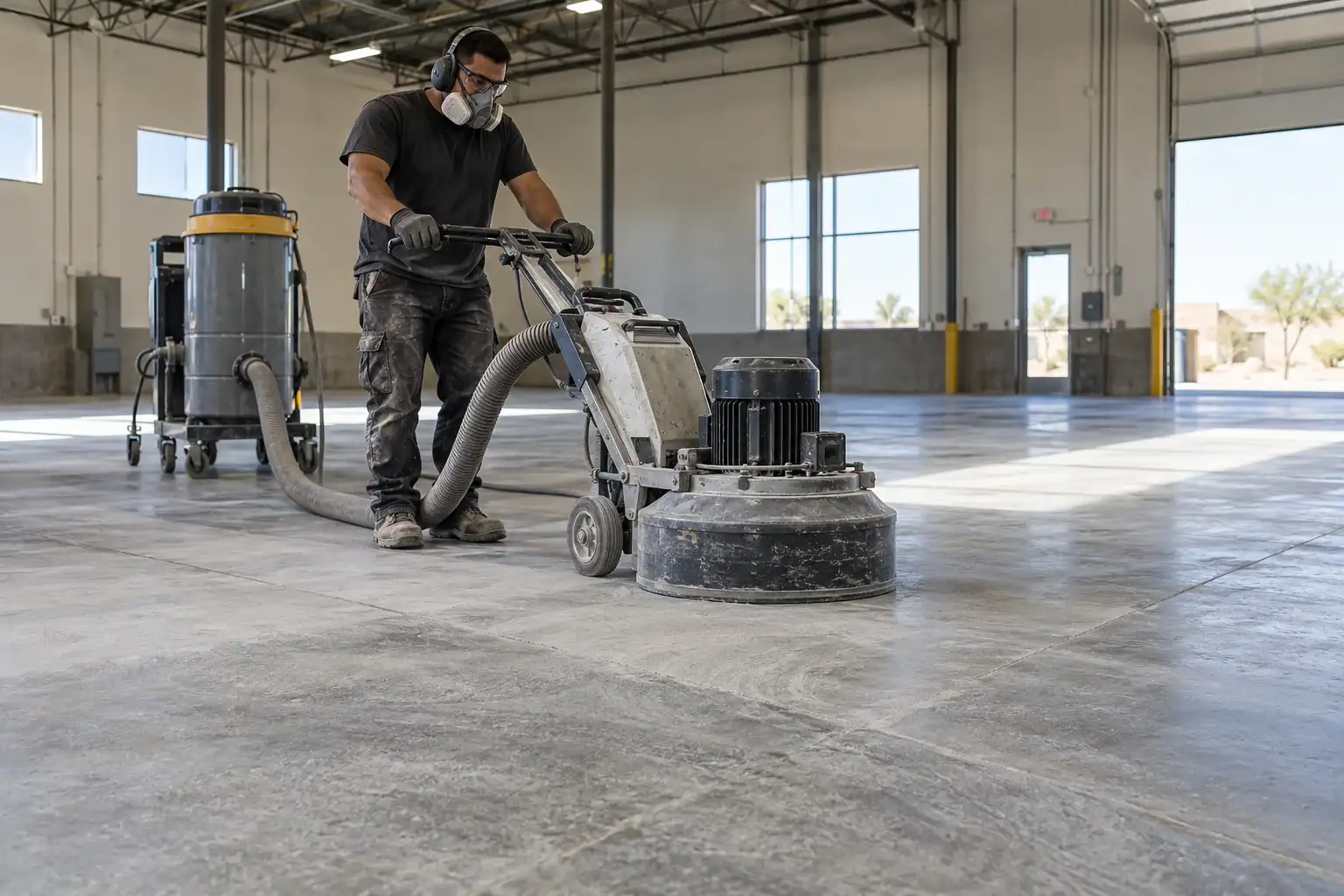
Diamond grinding is what gives a coating something to hold. An acid etch in place of a grind can leave a weaker bond, and an epoxy trade guide names a marginal bond as one of the 3 causes of hot tire pickup, alongside a product never rated for vehicle traffic and traffic let on before the vehicle cure.
Then the repairs: cracks filled, spalls patched flush with the field, oil pulled out of the pores. Oil left in a slab can make a floor let go in a tire-shaped patch, and a topcoat does not fix it.
A sealer or a curing compound still on the surface is the same failure in a different coat, which is why the grind gets judged by what it exposes and not by how clean the slab looks.
Stage 3 is often the slowest of the 5 and the one most likely to find what a phone call could not: a hollow spall, a crack that has moved, a coating that comes up in sheets.
Systems
Stage 4: base coat, broadcast, topcoat
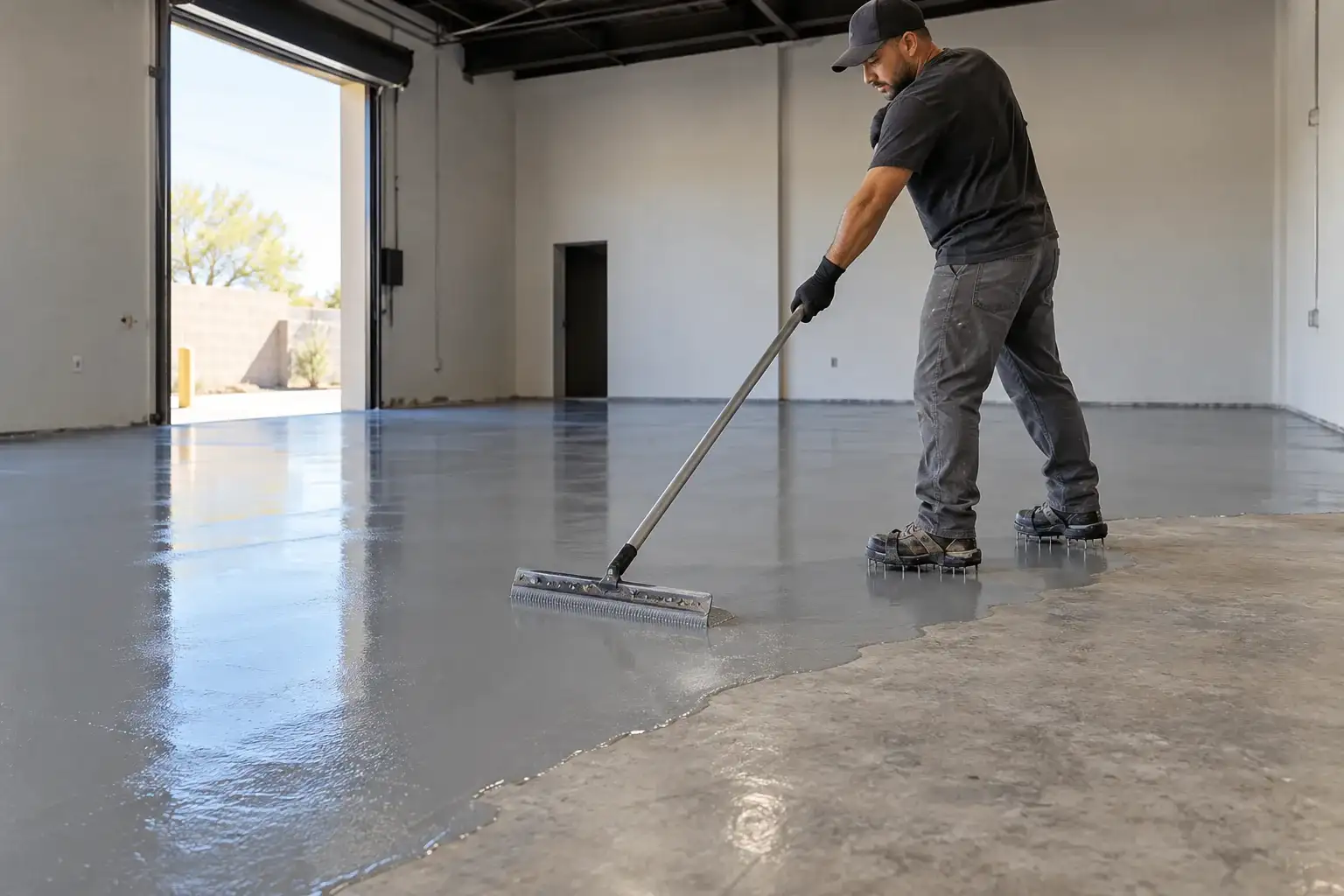
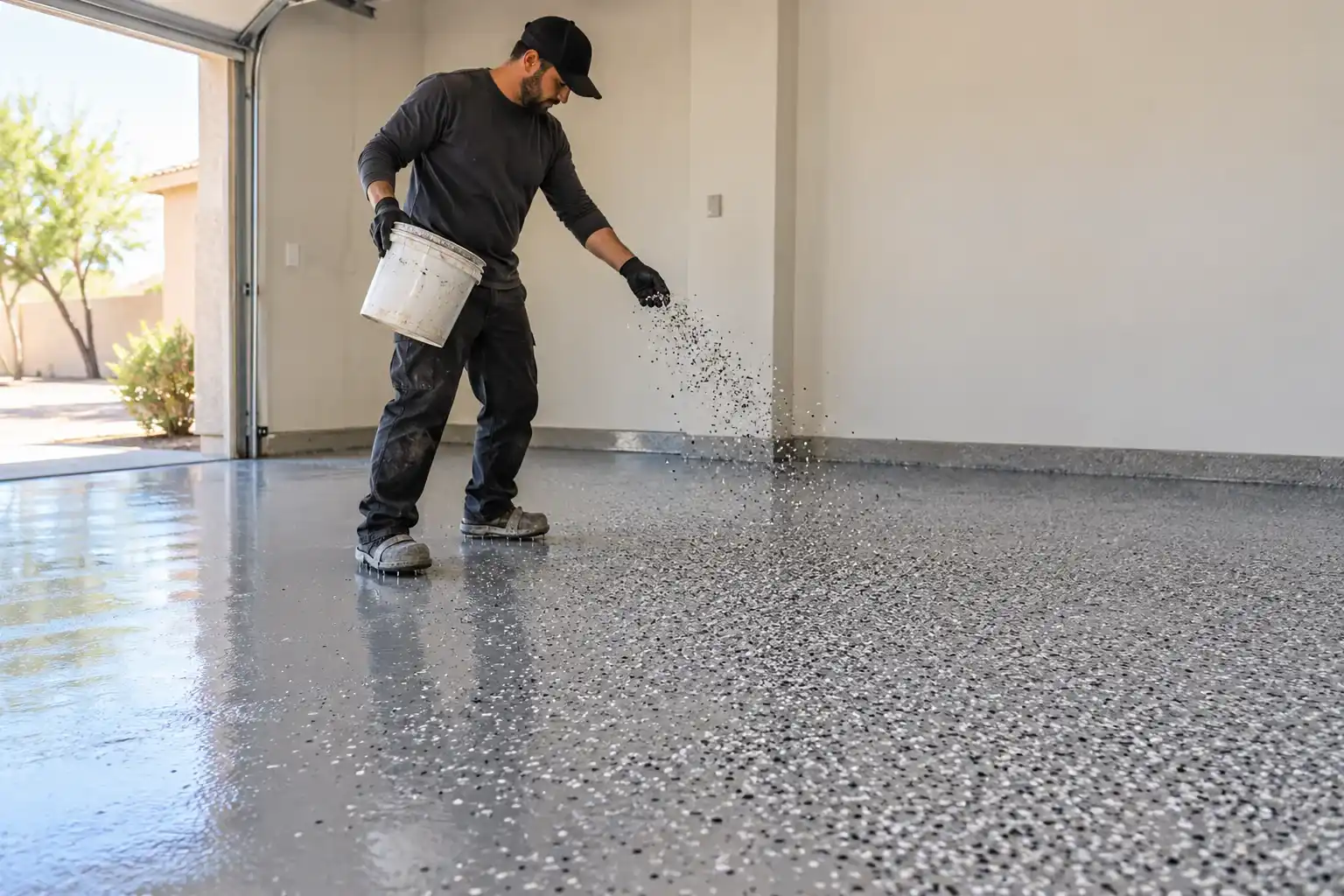
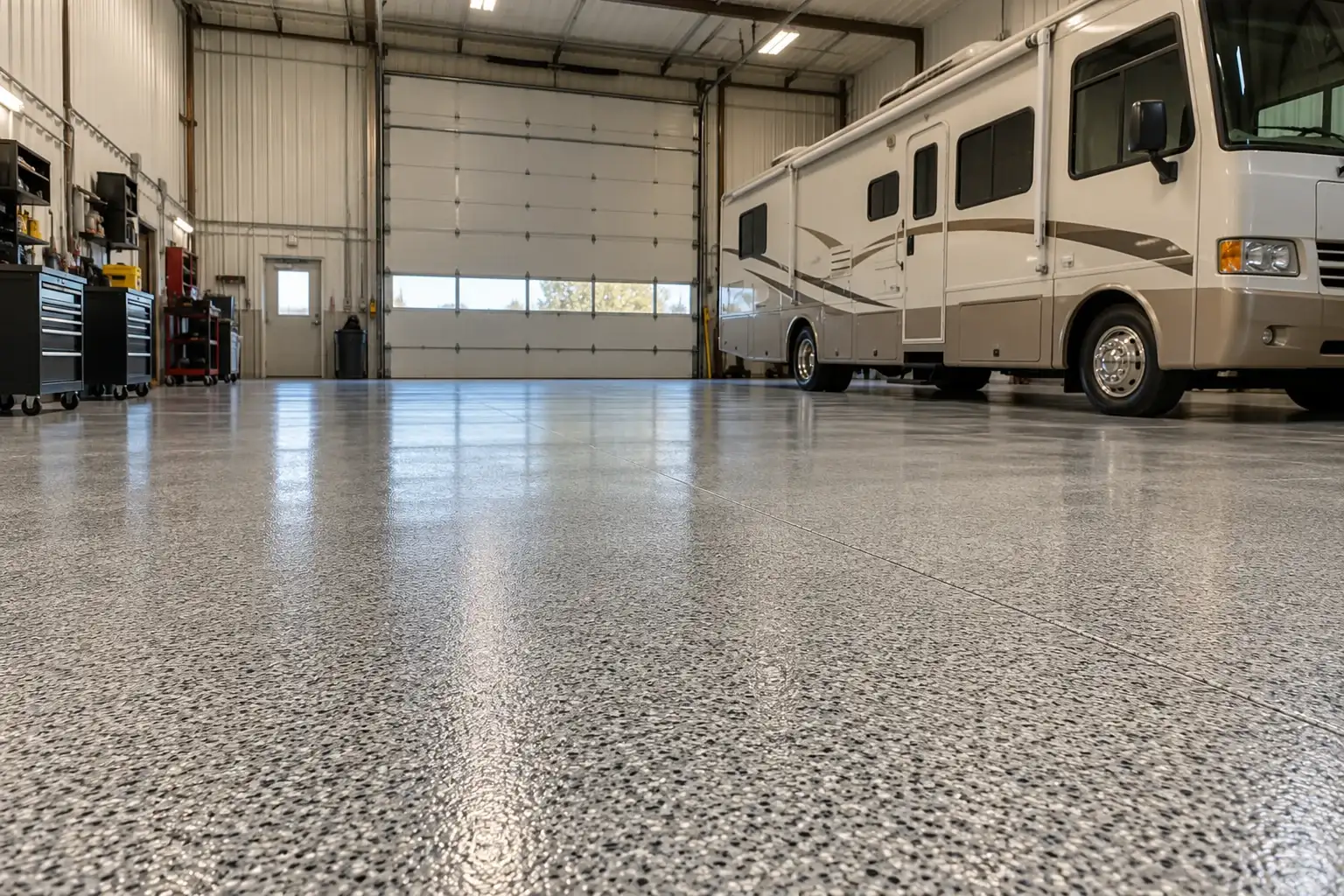
The order is fixed. A base coat goes down, flake or quartz gets broadcast into the wet film, the excess gets swept off once the base sets, and a topcoat goes over the whole thing to seal the texture in.
The broadcast has to land while the base is still open, so the day runs on stage times rather than on a clock on the wall. Build is where the systems separate: a flake garage floor lands at 20 to 30 mils dry, a quartz commercial floor at 40 to 60 mils, and each polyaspartic topcoat adds 3 to 5 mils, per an epoxy flooring guide.
More build means more material, more passes and more hours on site.
Good to know
Stage 5: cure, and the traffic clock
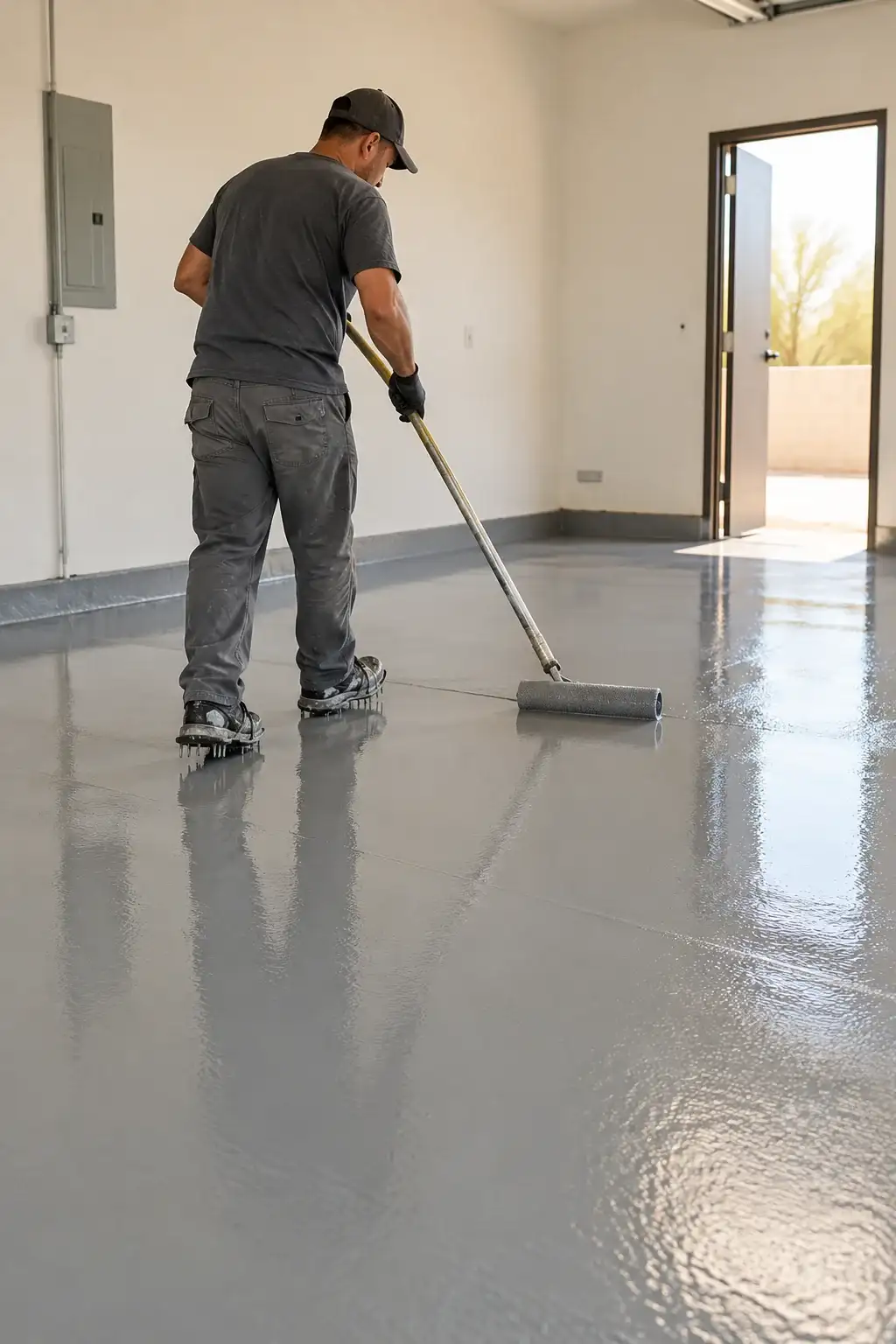
Epoxy coatings call for installation temperatures between 50 F and 90 F, per a garage floor coating company's guide. Some polyaspartic stages can cure in as little as 20 to 60 minutes.
The floor will look finished the same evening and still not be a garage. Light foot traffic at 12 hours, everyday use at 24, contents at 48, a vehicle at 96, and all 4 numbers come from one polyaspartic schedule in a garage floor coating company's guide.
The 96 hour mark is the one that matters here. That guide notes that tires can reach above 200 F after a drive, and that heat softens certain coatings enough for the rubber to bond with the surface. A car parked at hour 60 instead of hour 96 can be how a floor collects its first hot tire pickup.
Timeline
Why a Mesa July rewrites the schedule
July runs a normal high of 106 F and a normal low of 79 F in Mesa, with 1.18 in of normal precipitation, per NOAA's 1991 to 2020 normals (opens in a new tab) for the Mesa station. The application window for epoxy tops out at 90 F.
A slab in the sun can run hotter than the air above it, so a 106 F afternoon is not an install window. A thermometer on the slab decides, not the forecast, and the answer at 3 pm in July is usually no.
So the day moves. Grinding starts at first light, the base coat and the broadcast run while the slab is still cool, and the work stops when the slab crosses the top of the window. On a hot week that can put the topcoat on the second morning instead of the same afternoon, which is why a July date asks for more room in the calendar. Concrete expands in summer heat and contracts when it cools, per a garage floor coating company's guide, so the slab can be moving all day while the coating is trying to set.
January fails the window at the other end, when an unheated slab sits below 50 F overnight and the first coat waits for the sun.
Planning
What can move the date after the work starts
4 things move a date: a moisture reading over the threshold, a repair bigger than it looked, an old coating that has to come off, and heat. The first 2 turn up on the day of prep, the third gets found by the grinder, and the fourth is on the forecast. A date that holds through all 4 was built with room in it.
5 questions
Questions people ask
Still have a question? Call (747) 243-2089 and describe the floor.
Do I have to empty the garage?
Yes. Everything comes off the floor before the grind, and the contents stay out for 48 hours once the final coat is down on one polyaspartic schedule (a garage floor coating company's guide). A fridge or freezer that has to keep running is the one to plan around.
Can I walk on it the night it is done?
At 12 hours on one polyaspartic schedule (a garage floor coating company's guide), and light means no grit under a shoe. The film is still curing at that point, so a ladder dragged across it on the first day can leave a mark.
What if a monsoon storm hits during the job?
A monsoon storm can pause a Mesa install. An open garage with blowing rain puts water on a slab that has to stay dry, and the schedule waits. July carries 1.18 in of normal precipitation, per NOAA, and that water has to stay out of the garage.
Does the temperature have to stay under 90 F?
Yes for epoxy, which calls for installation temperatures between 50 F and 90 F, per a garage floor coating company's guide. In July that can mean a dawn start and a shorter working day, and in January it can mean waiting for the slab to come up to 50 F before anything gets mixed.
What happens to the old coating?
A coating that is lifting comes off before anything else goes down, and that can be a day of its own. A coating that is still holding gets ground and built over, which is a different schedule and a different number.