Service 06 of 06 · Mesa, AZ
Concrete prep and coating company in Mesa, AZ
You have a floor that peeled once already, or a quote that says prep is included without saying what that means, and you want to know what happens to the concrete before the coating goes on. Tell us what the old floor did, and someone from our team will call you back.
What you get
A slab that gives the coating something to hold
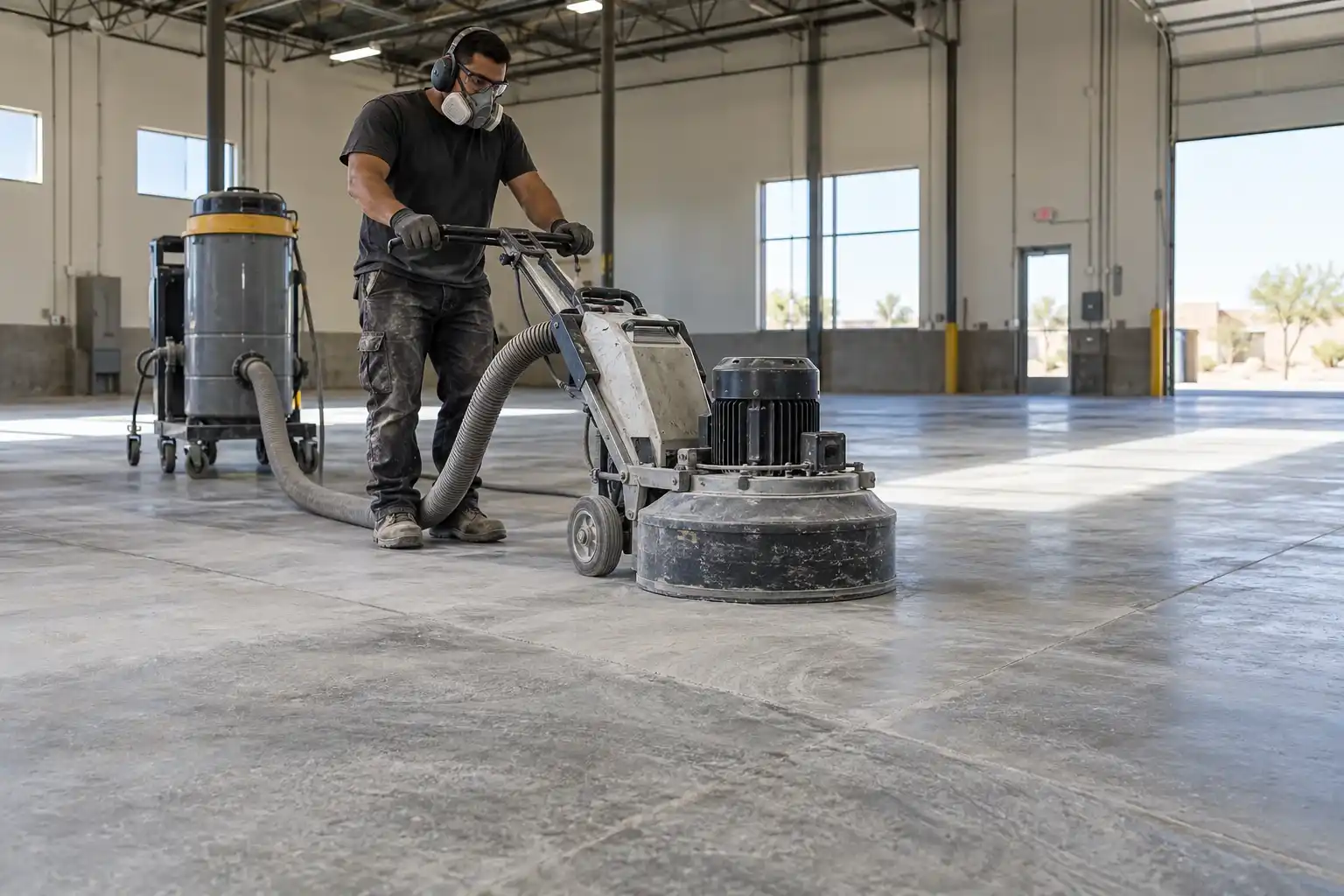
Concrete prep in Mesa is the part of the job that disappears under the finish and the part that decides how long the finish stays. Diamond grinding opens the surface, cracks and spalls get filled and leveled, oil and curing compound come out of the concrete, and the moisture gets measured before a single coat is mixed.
- A surface opened by diamond grinding, with the profile a coating keys into.
- Cracks and spalls filled and brought level with the slab around them.
- Oil, curing compound and old sealer taken out of the concrete, not covered over.
- A moisture reading on record before the first coat is opened.
- Dust held at the grinder with a shroud and a vacuum, not pushed through the house.
Signs
5 signs the slab under your floor was never prepped
The floor peeled in sheets
A sheet is a film that never attached, and sealer, curing compound or dust between coating and concrete can be why.
The concrete feels chalky
A chalky surface is a weak surface, and a coating holds to strength, not to powder.
Old sealer still beads water
A beading surface is a sealed surface, and a new coating cannot reach the concrete through it.
A crack that has opened wide
A wide crack can be moving with the slab, and it needs to be opened, filled and leveled before anything goes over it.
A patch that lifted at the edge
A patch that curled at the edge may have been feathered too thin or gone onto a surface that was not clean.
3 steps
How it works
Tell us what the old floor did
Peeled, blistered, flaked, or never coated at all.
We go over the slab with you, from the moisture reading to the repair list and the day it can take traffic
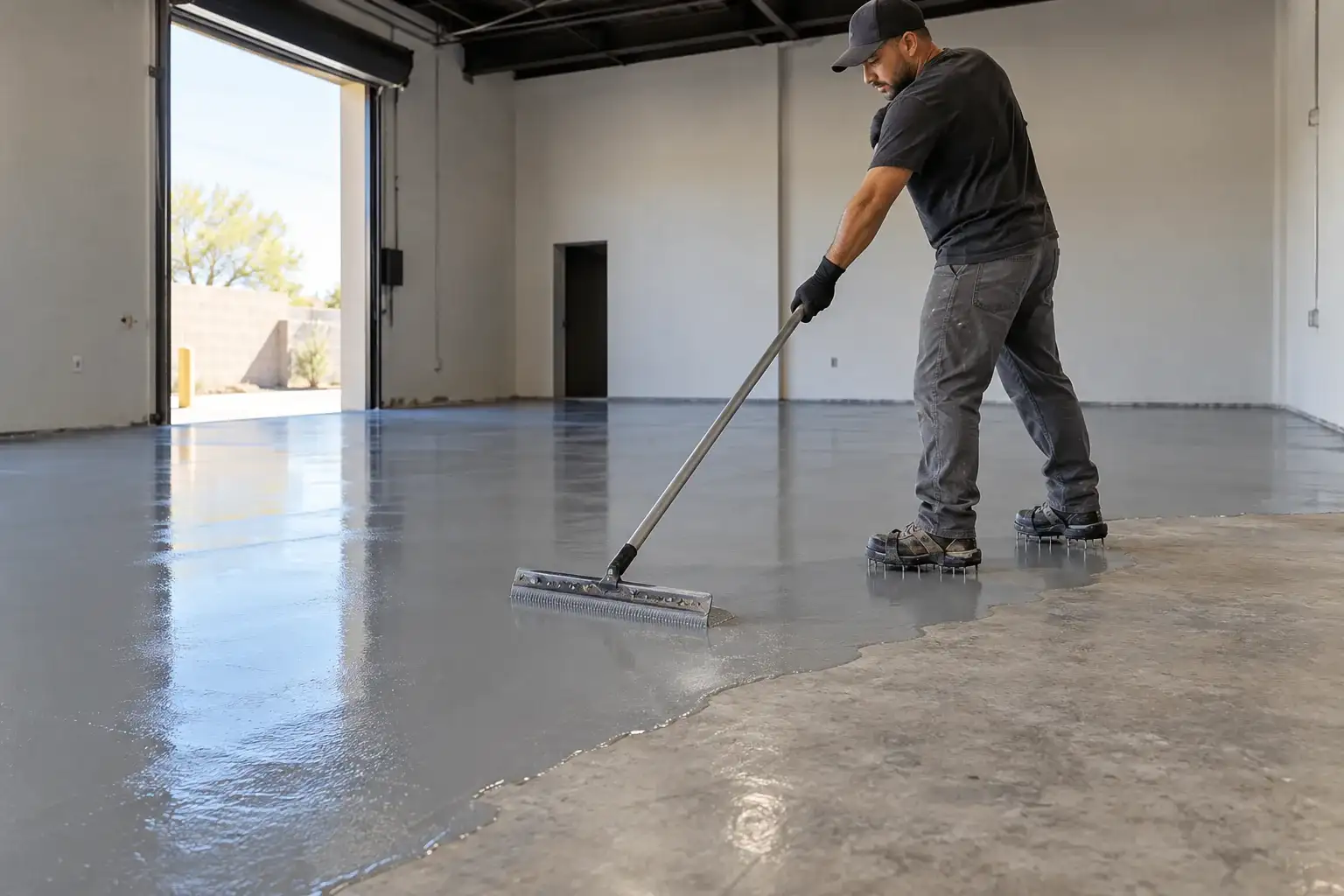
The slab gets ground, repaired and tested, and the coating goes on a surface that is ready for it
Costs
What the prep and the coating cost in Mesa
Prep is one of the factors behind the published coating numbers, which is why 2 prices for the same square footage can land at opposite ends of the range. Fixr puts concrete floor coating at $1,250 to $4,000 nationally, average $3,000, and epoxy over a concrete garage floor at $10 to $15 per sq ft installed (Fixr (opens in a new tab)). HomeGuide's installed epoxy figure runs $4 to $10 per sq ft, with a 2-car garage landing at $1,600 to $5,800 (HomeGuide (opens in a new tab)).
| Work | Published range | Source |
|---|---|---|
| Concrete floor coating, national | $1,250 to $4,000, average $3,000 | Fixr (opens in a new tab) |
| Epoxy over a concrete garage floor, installed | $10 to $15 per sq ft | Fixr (opens in a new tab) |
| 2-car garage, epoxy | $1,600 to $5,800 | HomeGuide (opens in a new tab) |
Published ranges, not a quote.
A slab that needs crack repair, oil removal and a full grind is the work that can put a floor near the top of those ranges. The same floor over clean, sound concrete can sit near the bottom.
The slab
Diamond grinding and acid etch are not the same start
Acid etch washes the surface with a mild acid and opens the pores. Diamond grinding cuts the top of the concrete off and leaves a profile a coating can key into. The 2 are not interchangeable, and a coating troubleshooting guide lists acid etch where a grind belonged among the reasons a coating lifts at the tire, next to a coating over a sealer or curing compound and a dusty slab.
The same guide separates 2 things that look alike on a floor. Pickup is coating leaving the slab, with bare concrete behind it. A stain is plasticizer and carbon sitting in a film that is still intact. Pickup can be a prep failure. A stain is cosmetic.
A coating over a slab that was never ground can come back off. That is one reason grinding comes first, and it shapes how the rest of the work goes.
The slab
Cracks, spalls and the repair that has to happen first
A crack is a moving joint, not a gap to be filled and forgotten. A slab grows in July heat and shrinks back as it cools, per a garage flooring guide, so a repair that goes in rigid in summer can be tested again when the slab cools. Cracks get opened to a clean edge, filled with a material that moves with the slab, and leveled, so the coating crosses a flat surface instead of climbing a ridge.
A spall runs the other direction: a patch of surface that came off and left a shallow crater. It gets cleaned back to sound concrete, primed and filled, then ground level with the field around it. A spall left alone can telegraph through a coating within a season, and its edge is where the film can start to lift.
Signs
Moisture is the failure nobody sees coming
Concrete holds water and gives it up slowly. A coating over damp concrete cannot attach, and it bubbles or peels instead, which is why the moisture reading comes before the coating and not after, per a garage flooring guide. Two published pass marks decide it: a relative humidity reading under 75 percent on an in-slab probe run to ASTM F2170, or an emission rate under 3 lb per 1,000 sq ft per 24 hours on ASTM F1869, per an epoxy flooring guide.
A slab that reads over either number needs a plan for the moisture before a coating gets picked. No topcoat fixes a wet slab.
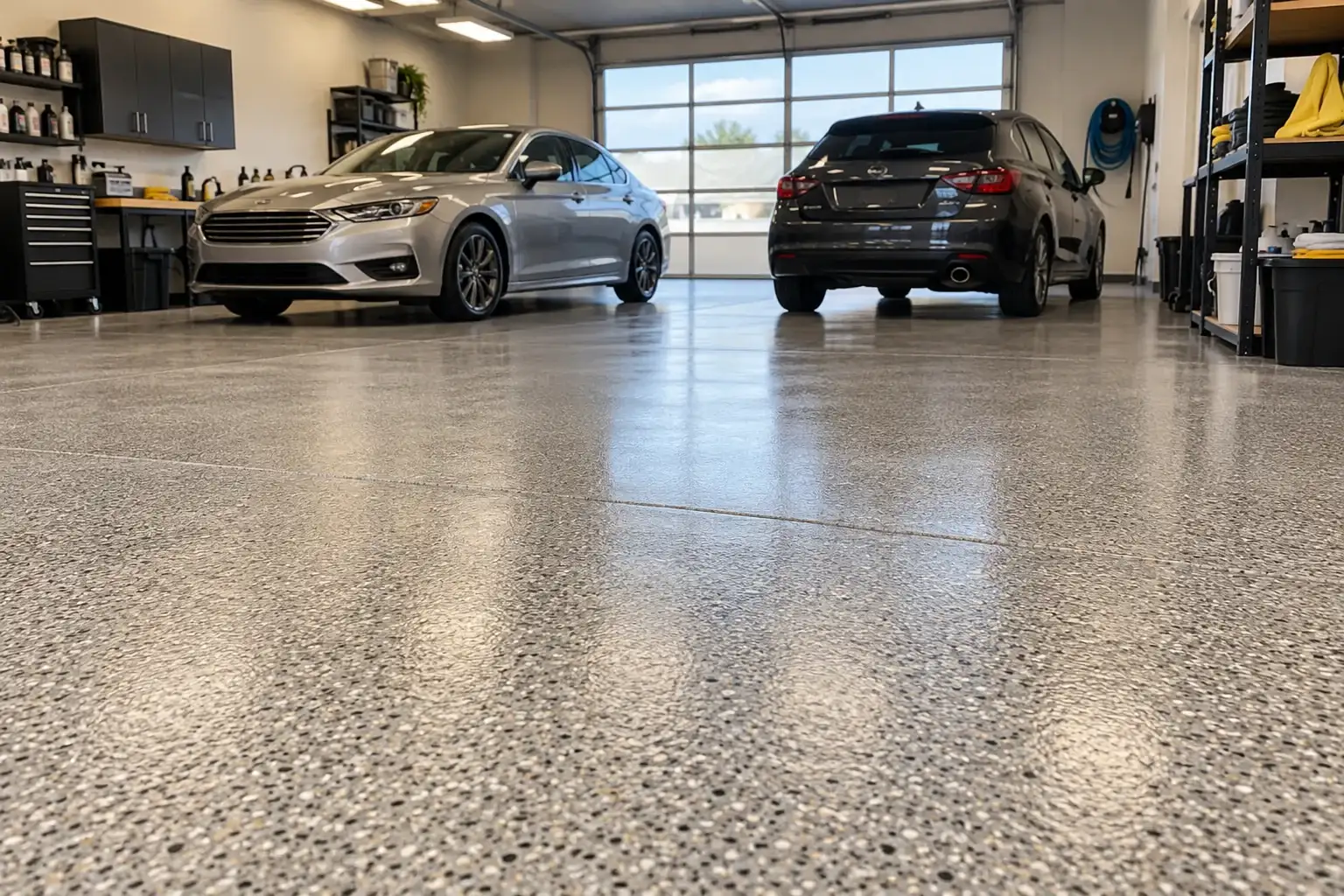
Good to know
The 50 F to 90 F window, the sealer and the dust
The working window for epoxy is 50 F to 90 F, per a garage flooring guide, read on the slab as well as in the air. In Mesa the window can close in summer, and winter nights fall below it too (the December normal low is 40 F, NOAA NCEI 1991-2020 normals, station USC00022782). A slab in the sun can run hotter than the air above it, so a July job starts at dawn and the slab gets checked with a gauge instead of a hand.
A slab that has been sealed or painted is a surface with something on it. Sealer and paint come off mechanically before a coating can reach concrete, and a curing compound left from the pour is the same problem in a thinner film. Grinding takes all 3 off. A chemical wash may not.
Dust is the last part of prep and the first thing a household notices. The grinder runs inside a shroud hooked to a vacuum, the door gets taped, and the path from the work area to the door gets covered. Dust that settles inside a house can keep turning up.
5 questions
Questions people ask
Still have a question? Call (747) 243-2089 and describe the floor.
Does a floor that was never coated still need grinding?
Yes, if it is going to take a coating. New concrete can carry a curing compound and a weak top layer, and both sit between the coating and the concrete. A grind takes that layer off and leaves a surface with a profile that holds.
Can a coating go over paint or sealer?
Not directly. Paint and sealer come off first, and the mechanical way to do that is a grinder. A coating over a sealed floor sits on the sealer, and when the sealer lets go the coating goes with it.
What decides how long prep takes?
Cracks, spalls, oil and moisture. A sound slab that needs a grind is the short version, and every repair adds a step that has to cure before the next one starts. The schedule gets set after the slab is looked at, not before.
What does a moisture test involve?
An in-slab probe reads relative humidity, and a calcium chloride test reads the moisture emission rate. The numbers to beat are 75 percent relative humidity on an ASTM F2170 probe, or 3 lb per 1,000 sq ft per 24 hours on an ASTM F1869 test, per an epoxy flooring guide.
What if the old floor is peeling in sheets?
Then prep starts with removal, not with a new coat. A floor peeling in sheets is a film that never attached, and the cause sits under it: sealer, curing compound, dust or moisture. All of it comes off, the slab gets ground, and the new coating starts on concrete instead of on the old film.
Keep reading
Related
- Garage floor epoxy in Mesa
- Polyaspartic and epoxy compared
- Commercial epoxy for shops and bays
- Epoxy flooring cost in Mesa
- The Mesa epoxy flooring guide
- Queen Creek epoxy flooring
- Apache Junction epoxy flooring
- Industrial Epoxy Flooring: Call (747) 243-2089
- Residential Epoxy Flooring: Call (747) 243-2089
- How an install runs
- Floor looks
- Areas around Mesa