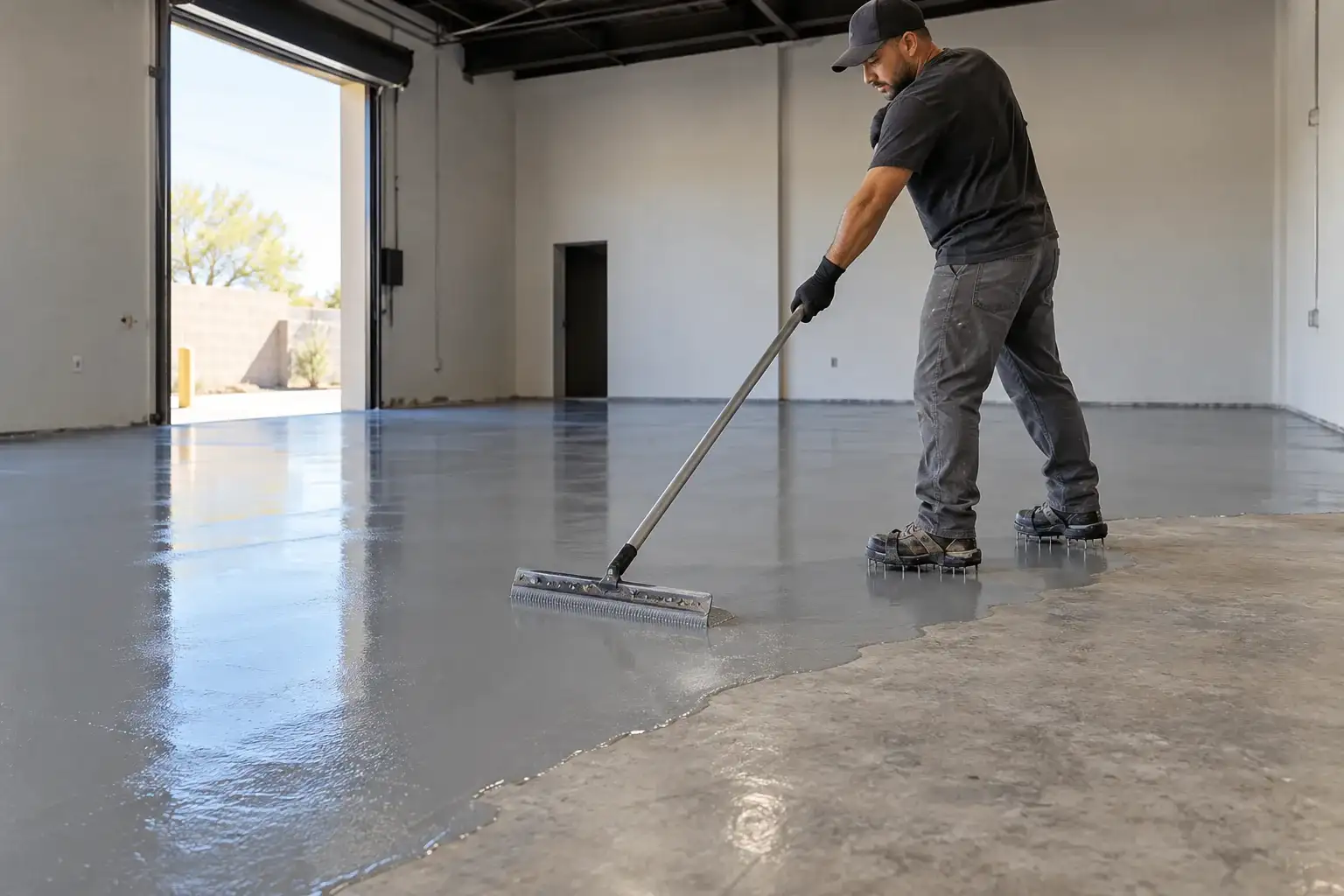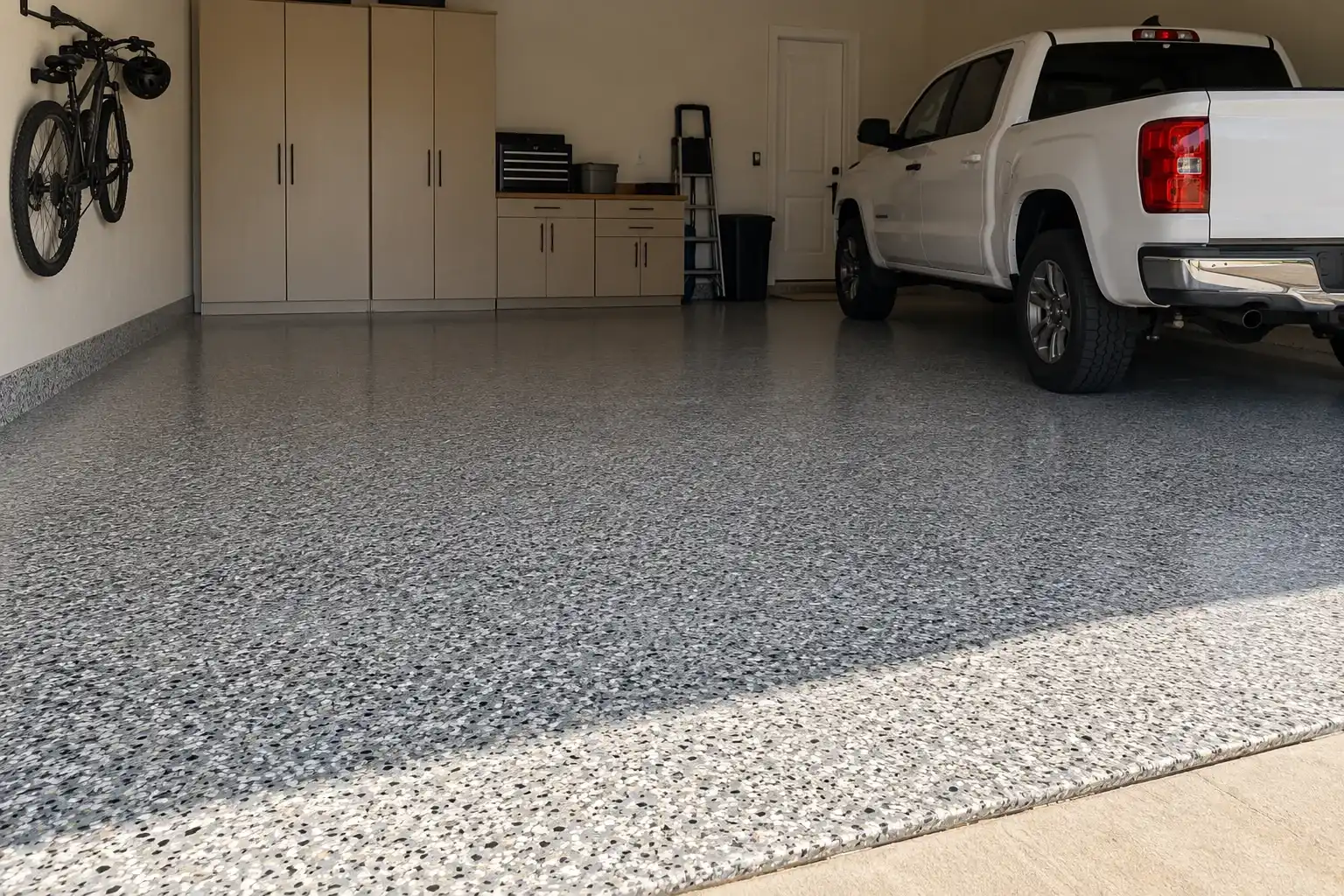
Service 02 of 06 · Mesa, AZ
Garage floor epoxy company in Mesa, AZ
You want a garage floor that still looks finished after a Mesa summer of hot tires and sun through a west-facing door, so tell us the bay count and what parks on it, and someone from our team calls you back.
What you get
What you get on a garage slab
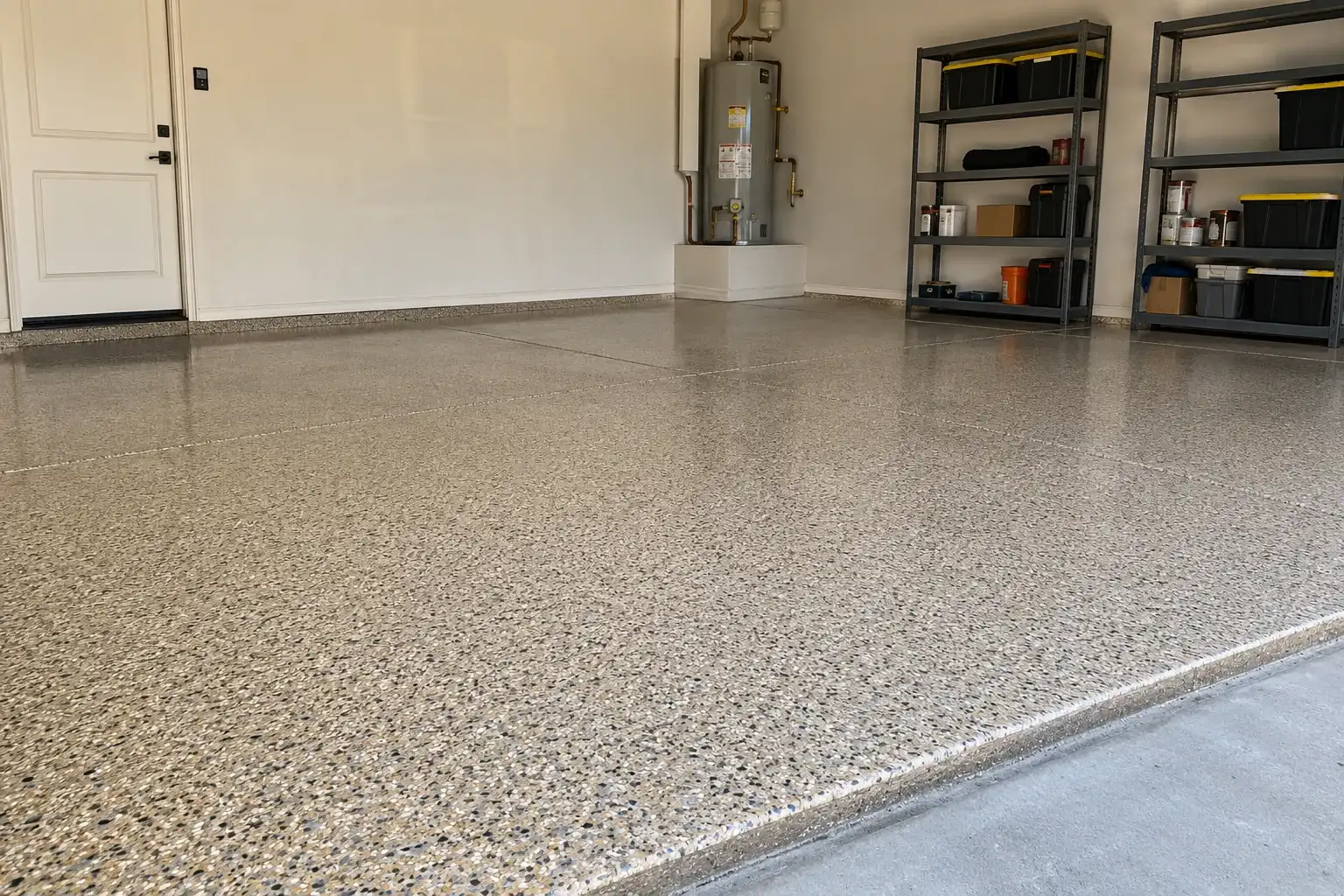
Garage floor epoxy in Mesa comes down to 3 builds: flake, metallic and solid. A flake build at 20 to 30 mil dry film buries colored vinyl flake in the base coat and seals it under a clear coat, so the floor hides tire marks and the small cracks a 20 year old slab carries. A metallic build flows pigment through the base and reads as one continuous surface, and it shows flaws in the concrete, so the prep matters more. A solid build, 10 to 20 mil of epoxy with a polyaspartic clear on top, costs less than a flake build and can show tire marks sooner. An epoxy flooring guide lists those thicknesses by system.
- Tire marks that wipe off, because the film is rated for vehicle traffic and the cure clock was honored.
- Color that holds behind a west-facing door instead of going amber.
- Oil and coolant that come up off the film instead of soaking into bare concrete.
- Cracks and spalls at the apron filled before the flake goes down, so they are less likely to telegraph up through the film.
- The hour the car goes back in, written down before the job starts.
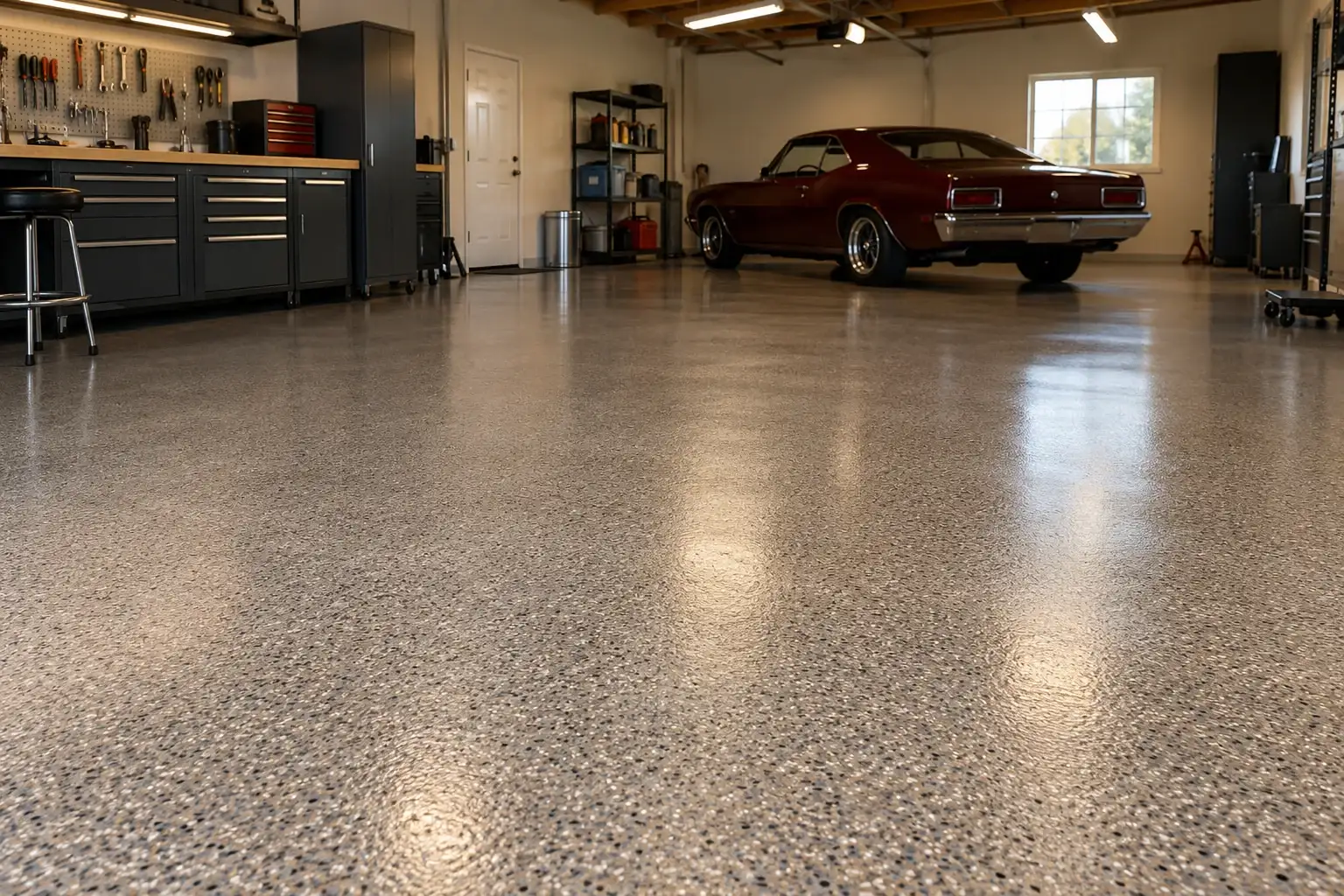
Signs
6 signs your garage floor needs attention
Hot tire marks that no longer wash off
A mark that scrubs away is plasticizer and carbon sitting in the film. A mark with bare gray concrete under it is pickup, and the coating has left the slab, as a coating troubleshooting guide describes it.
Peeling at the door threshold
Sun, rain blowing under the door and the slab edge moving all meet in the same narrow strip, so the film often lets go there first and works its way back into the bay.
Yellowing behind a west-facing door
Epoxy has no built-in UV protection and visibly discolors in sun, per a garage flooring guide, and the door that takes the afternoon sun is a likely place for it to show up first.
Oil shadows that keep coming back
A stain that returns after cleaning has likely soaked into the concrete, and it can show through a coating until the oil is drawn out and the slab gets ground.
Dusting under the tires
Fine powder on the slab is the concrete surface abrading, and a coating over a dusting slab can fail to hold until the surface gets ground back to sound concrete.
Cracks opening at the apron
Concrete expands in summer heat and contracts when it cools, per a garage flooring guide, and the apron joint is a common place for that movement to show up.
3 steps
How a garage floor gets built
The bays get emptied and the slab gets read
Oil, cracks, spalls, the apron joint and the moisture reading all get noted before a color gets picked.
The slab gets ground, patched and tested
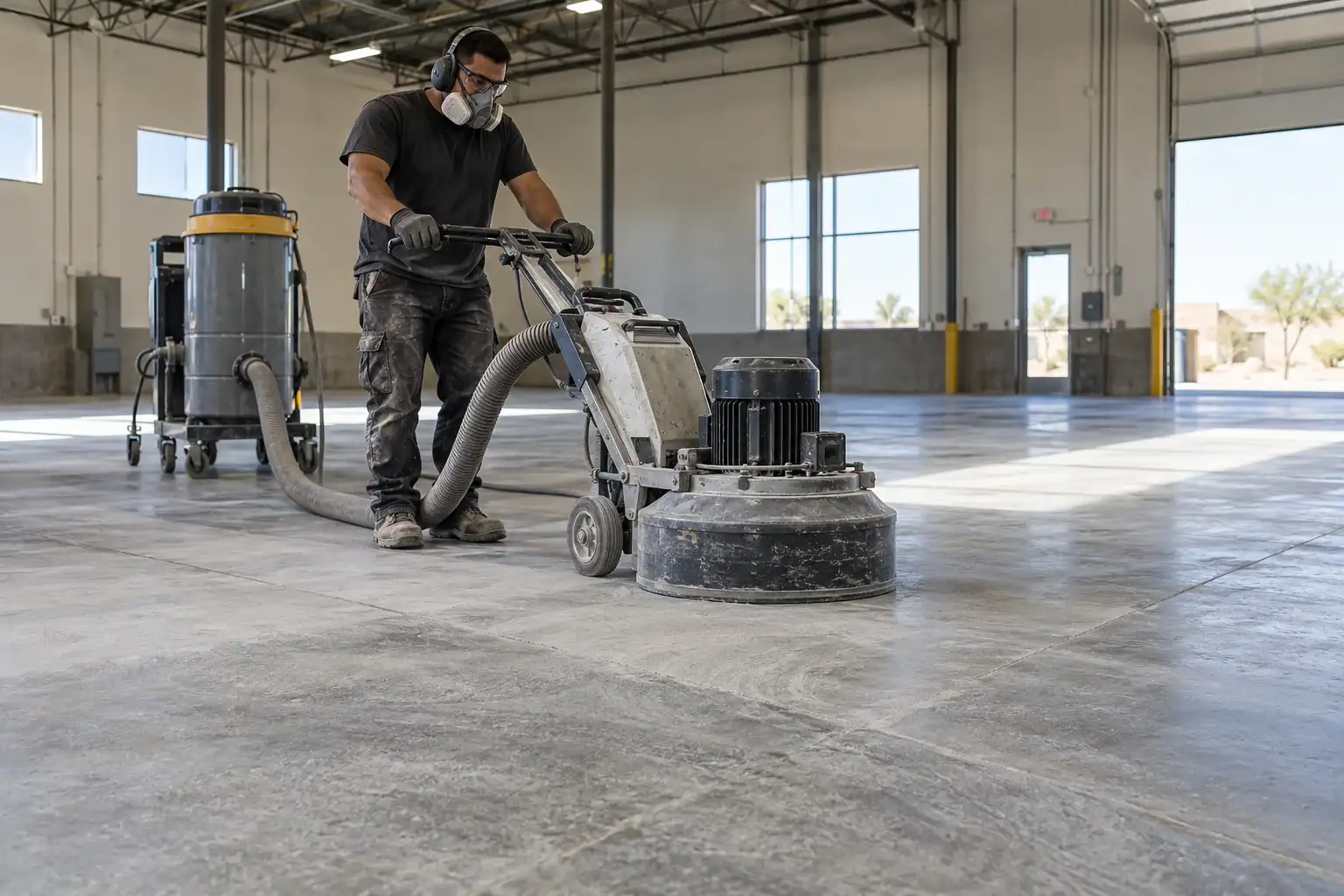
Diamond grinding opens the pores, cracks and spalls get filled, and a moisture test decides whether a mitigation coat goes down first.
Base coat, flake or metallic, then the clear topcoat
The flake goes into the wet base coat, the clear seals it, and the car stays out until the rated vehicle cure is done, which is 96 hours on a polyaspartic system in warm conditions.
Finish studio · 4 looks
What garage floor epoxy costs in Mesa
Garage floor epoxy in Mesa runs $1,200 to $3,900 for a 1-car bay, $1,600 to $5,800 for a 2-car and $2,300 to $8,600 for a 3-car, per HomeGuide (opens in a new tab), with material and labor inside those numbers. HomeGuide's wider garage floor coating figure runs $4 to $12 per sq ft and $1,600 to $6,900 for a 2-car across all coating types, and a Bob Vila (opens in a new tab) article updated in April 2024 puts the national average at $2,441 inside a $1,595 to $3,337 range. The gap between the sources is the build: a flake floor at 20 to 30 mil and a thin roll-on kit are not the same product.
| Garage or scope | Published range | Source |
|---|---|---|
| 1-car garage, epoxy | $1,200 to $3,900 | HomeGuide |
| 2-car garage, epoxy | $1,600 to $5,800 | HomeGuide |
| 3-car garage, epoxy | $2,300 to $8,600 | HomeGuide |
| All coating types, 2-car | $1,600 to $6,900, or $4 to $12 per sq ft | HomeGuide |
| Single garage, installed | $1,594 to $3,330 | Family Handyman |
| National average, epoxy garage | $2,441 within $1,595 to $3,337 | Bob Vila, 2024 |
Published ranges, not a quote.
A 12 by 24 ft 1-car bay is 288 sq ft and a 24 by 36 ft 3-car is 864 sq ft, per HomeGuide, and the small end still carries the same mobilization, grinder and moisture test as the big end. A 3-car with a step, a water heater in the corner and a cracked apron adds detail work that a bare 2-car does not.
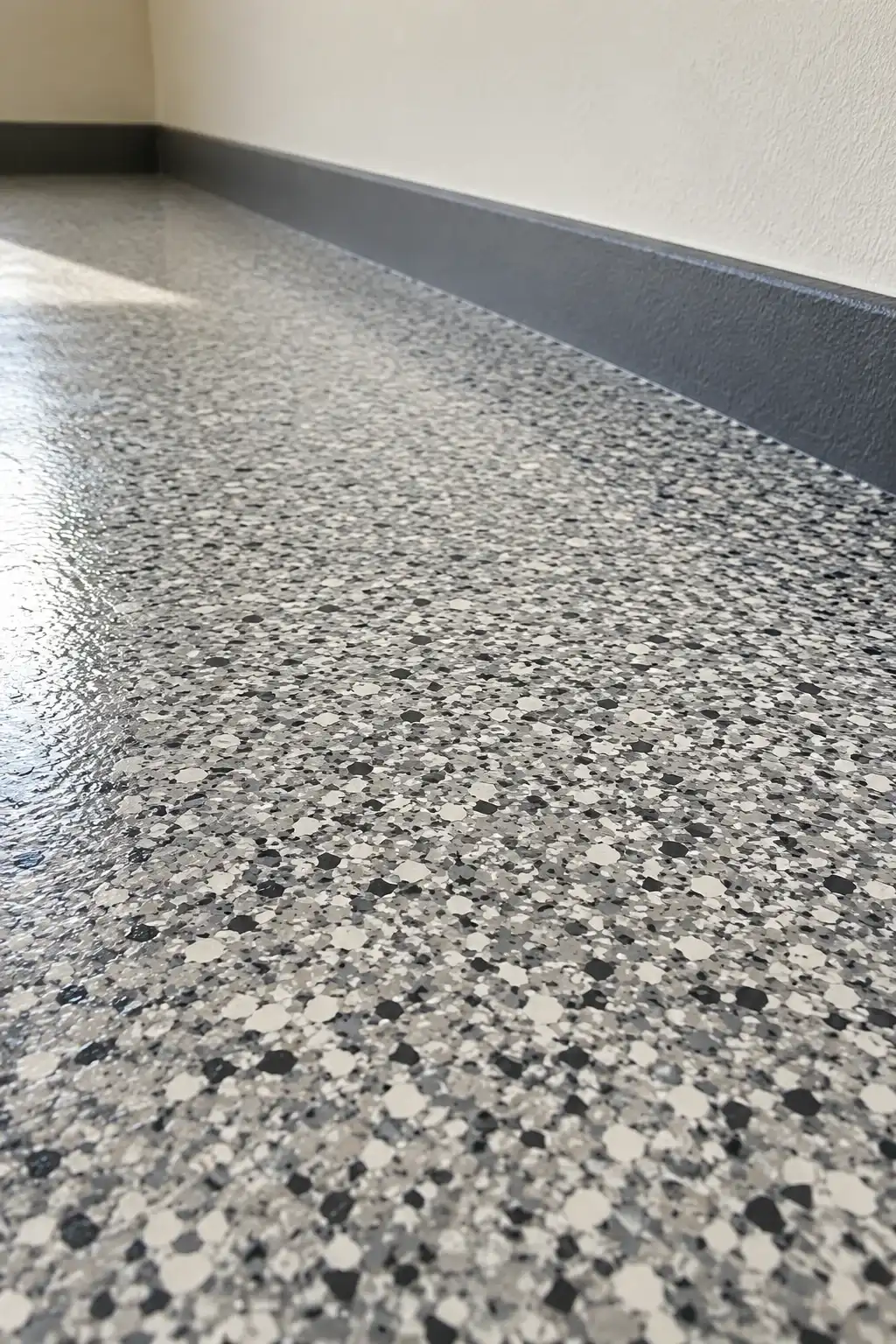
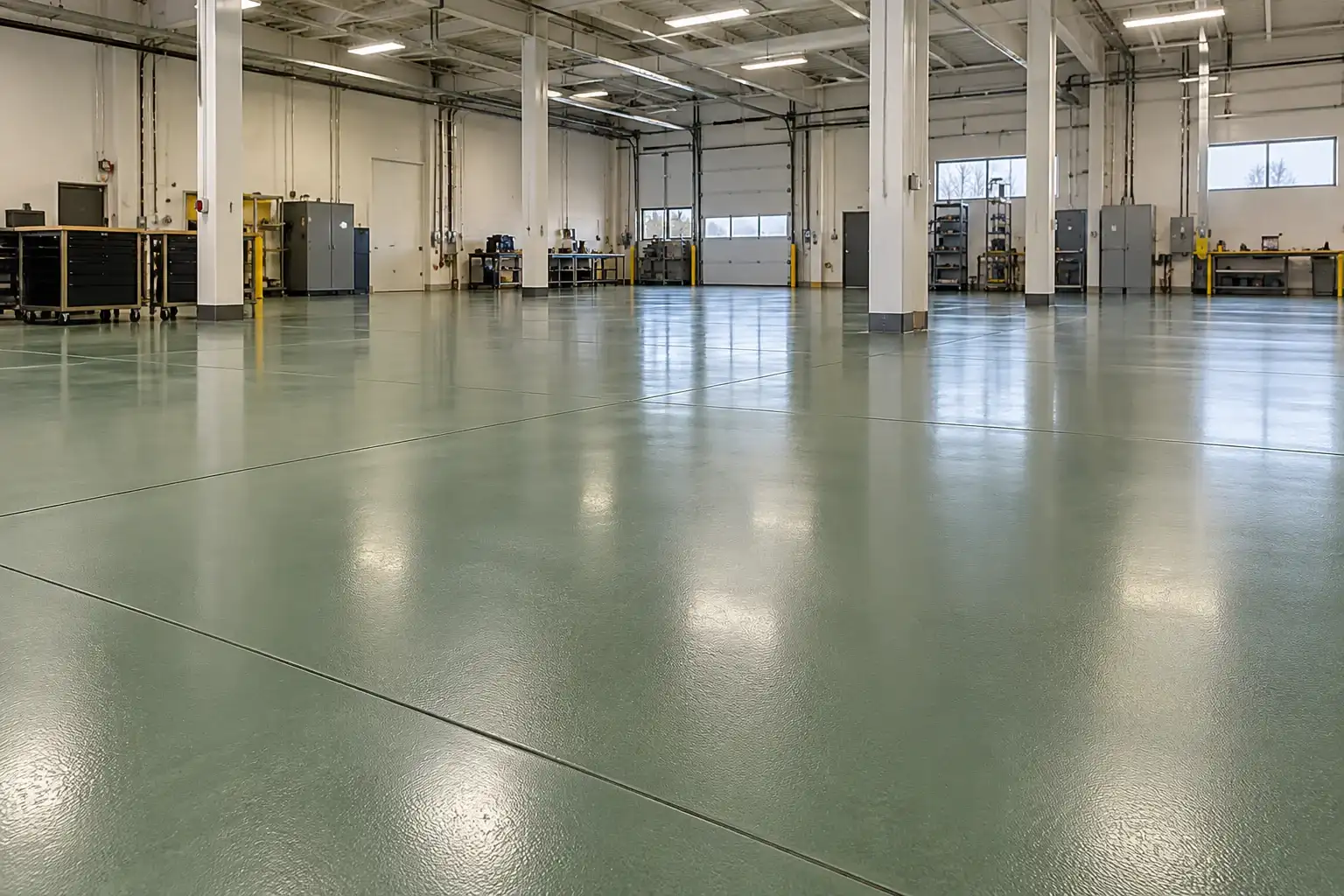
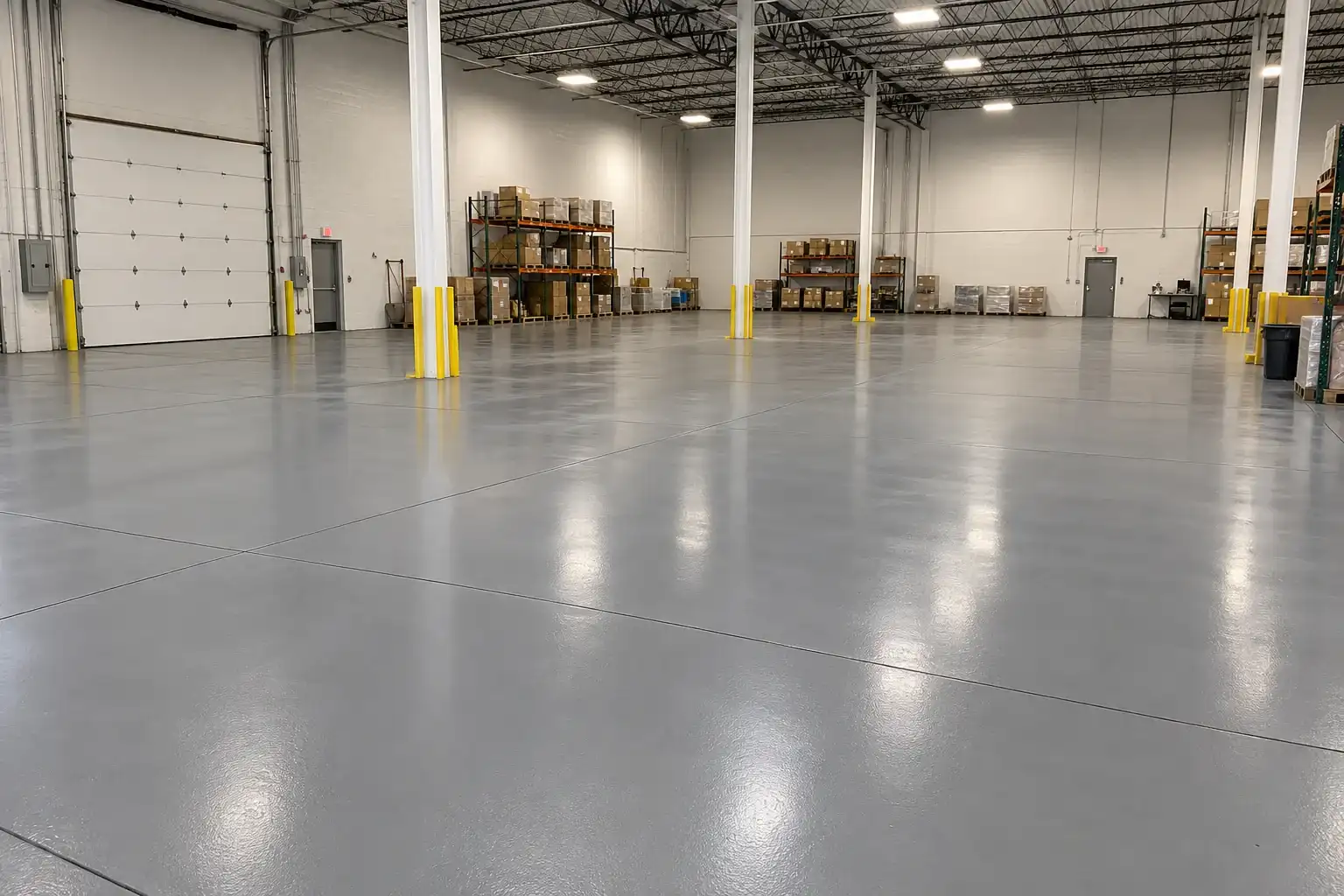
Sun and heat
Hot tire pickup has several causes, and the product is only one
A coating troubleshooting guide lists 5 causes. The first 3 are a product never rated for vehicle traffic, driving on it before the rated vehicle cure, and a bond that was marginal from the start, and the list adds a missing or wrong topcoat and a film thinner than the specification. The bond cause is easy to miss, because it is the prep: acid etch instead of diamond grind, a coating over a sealer or a curing compound, or a dusty slab that was never opened up. Add heat and it can let go. Tires can reach above 200 F after a long drive, per a garage flooring guide, which can soften some coatings at the contact patch and pull them off the concrete.
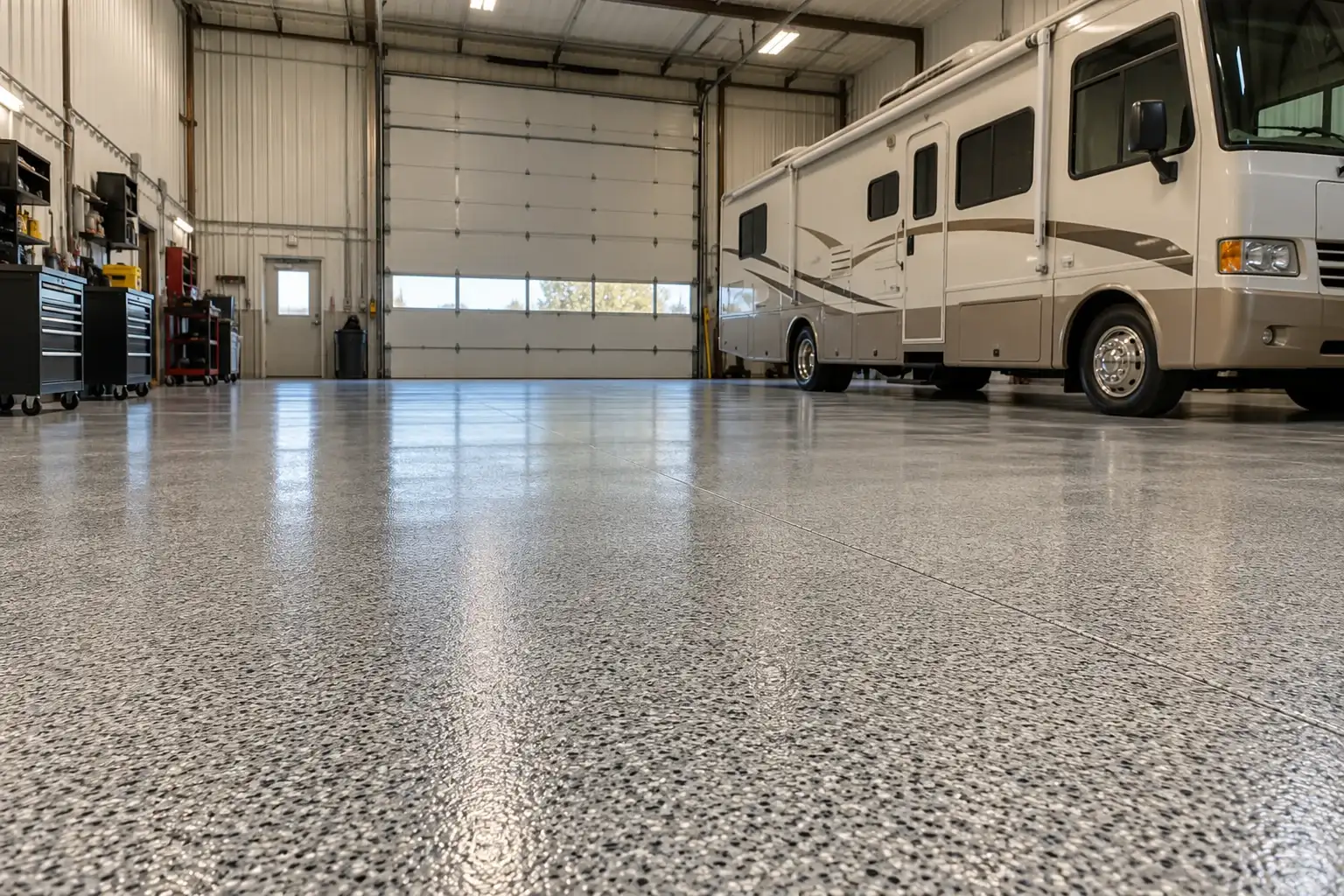
Planning
Why the west-facing door goes yellow first
Epoxy has no UV protection built in and visibly discolors over time in sun, per a garage flooring guide. Polyaspartic is more UV stable and more flexible than standard epoxy, per the same guide, and some builds pair an epoxy base with a polyaspartic topcoat so the color sits under a layer that can take sun. An epoxy flooring guide puts a polyaspartic topcoat at 3 to 5 mil per coat, so the coat count on a west-facing door is worth settling before the work starts.
Moisture
Moisture under the slab decides whether any of it holds
A coating over damp concrete cannot fuse to it, so it bubbles or peels, and a garage flooring guide calls moisture the leading cause of coating failure. The 2 tests that settle it, per an epoxy flooring guide: under 75 percent relative humidity on an ASTM F2170 in-slab probe, or under 3 lb per 1,000 sq ft per 24 hours on an ASTM F1869 test. A slab on grade with no vapor barrier is where a wet reading can turn up, and the reading gets taken before the work starts.
5 questions
Questions people ask
Still have a question? Call (747) 243-2089 and describe the floor.
How long before I can park on it?
In warm conditions a garage flooring guide gives the polyaspartic clock as 20 to 60 minutes for certain stages, light foot traffic at 12 hours, everyday use at 24 hours, garage contents at 48 hours and vehicle traffic at 96 hours (96 to 120 hours in cold conditions). The 96 hour mark is the one that matters, since a warm tire on a film that is still curing can start pickup.
Will flake hide the oil stains in my slab?
Flake hides color variation and small marks, not oil that is still in the concrete. Oil gets drawn out and the slab gets ground before the base coat goes down, because a stain under a coating can keep spreading and show through a light flake as a dark patch. A darker flake blend covers more than a light one.
Which system suits a 3-car garage?
A flake build at 20 to 30 mil, unless the slab is in poor shape or the look matters more than the wear. Flake carries the traffic of 3 bays, hides tire marks and often costs less than metallic. Metallic suits a 3-car that is mostly show space, since it shows flaws and scuffs.
Can a garage floor be coated in July?
It can be, with the schedule built around the heat. Epoxy needs air and slab between 50 F and 90 F, per a garage flooring guide, and Mesa's July normal high is 106 F with a normal low of 79 F (NOAA NCEI 1991-2020 normals, station USC00022782). A closed garage holds heat, so summer work starts early and the door comes up before the slab gets above the range.
What causes peeling right at the garage door?
Often water and sun at the same edge. Rain blows under the door, the slab edge takes the afternoon sun, and the film along that line is often the first to lift. A build that carries the coating to a proper edge and seals the joint can hold longer than one that stops at the weatherstrip.
Keep reading
Related
- Commercial epoxy flooring: for shop floors, kitchens and showrooms.
- Residential epoxy flooring: for patios, laundry rooms and workshops.
- Polyaspartic and epoxy compared: for cure speed and color hold.
- Epoxy flooring cost: for ranges by system and by square footage.
- The Mesa guide: for prep, moisture and thickness in one place.
- Industrial Epoxy Flooring: Call (747) 243-2089
- Concrete Prep and Coatings: Concrete prep in Mesa is the part of the job that disappears under the finish and the part that decides how long the finish stays.
- How an install runs
- Floor looks
- Areas around Mesa