Service 03 of 06 · Mesa, AZ
Industrial epoxy flooring company in Mesa, AZ
You have loaded tires turning on the same stretch of slab every shift, and a floor that has to still be there at the end of the year. Send the bay size and the shift pattern, and someone from our team calls you back to go over the build.
What you get
A floor built for loaded tires, not for a photograph
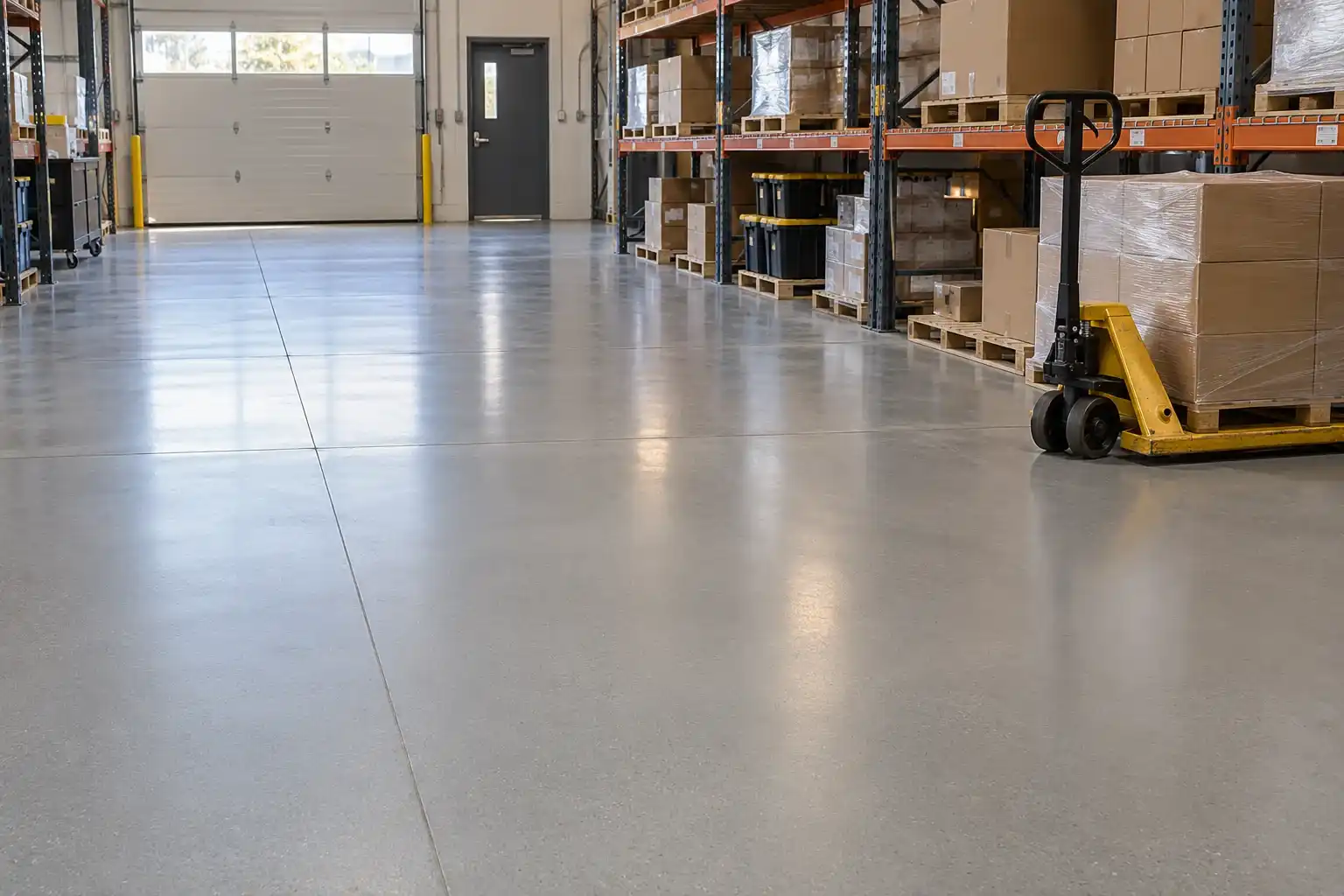
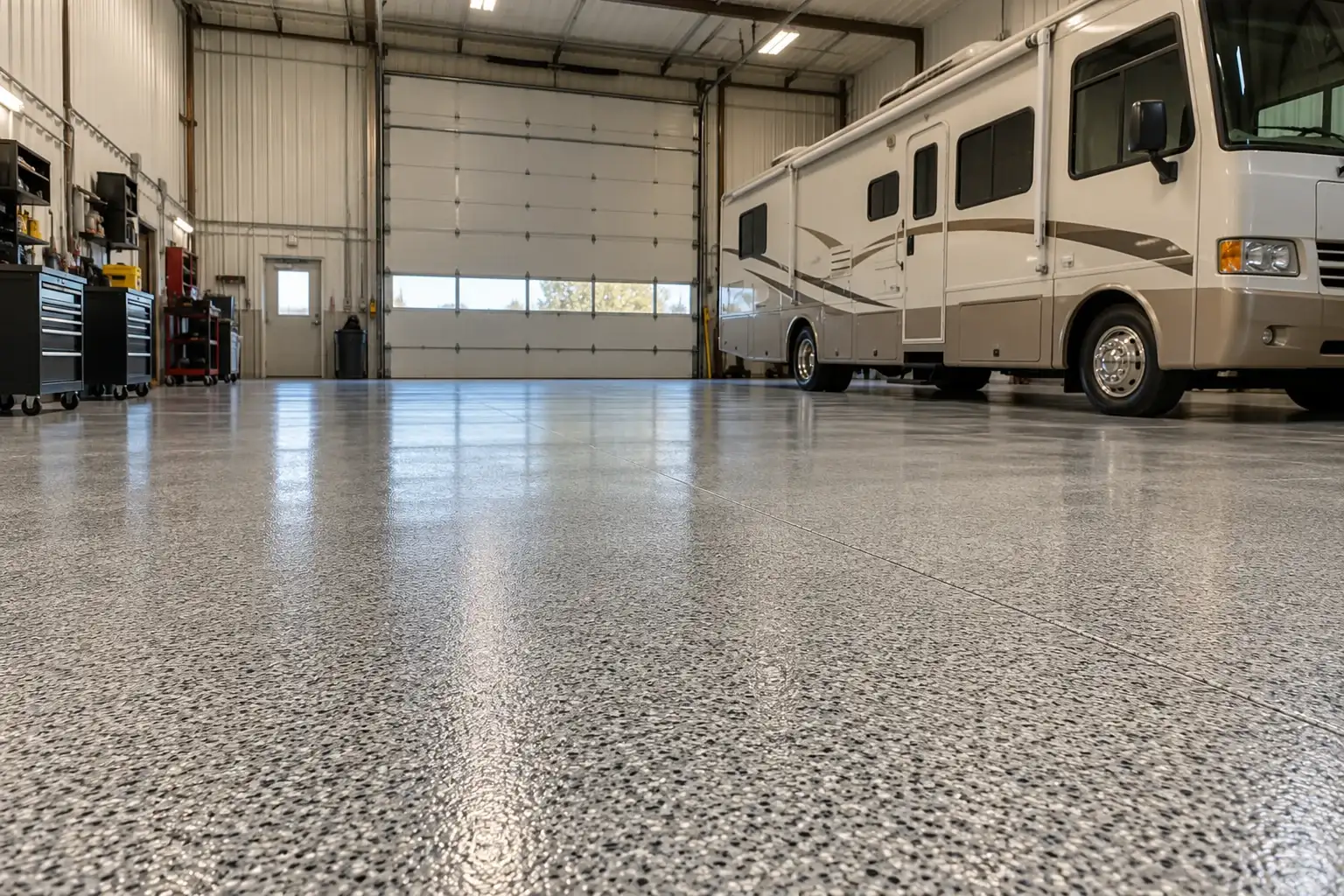
Industrial epoxy flooring in Mesa is a build decision before it is a color decision. A warehouse bay off the Gateway corridor, a service bay near Falcon Field or a light manufacturing floor needs a system thick enough to take steel wheels, dragged pallets and a chemical drip that sits until the end of the shift. An epoxy flooring guide puts self-leveling and troweled industrial systems at 60 to 250 mil of dry film, and the same published table puts a two-coat solid epoxy at 10 to 20 mil. A mil is one thousandth of an inch.
The build follows the room. Tell us what rolls across the slab, what lands on it and how it gets cleaned, and the specification comes out of those 3 answers.
- A film thick enough that abrasion wears the surface instead of opening the concrete underneath.
- Moisture measured before anything is mixed, so the coating has a slab it can stay fused to.
- Joints, cracks and spalls filled and detailed, so a 20,000 sq ft bay reads as one surface.
- Chemical resistance chosen for the real drip: coolant, hydraulic oil, degreaser or food plant washdown.
- A work window planned around your shipping calendar, not around a start time that suits the work.
Signs
6 signs the floor has already started to let go
Coating peeling in sheets near the dock door
A tire that turns under load shears the film sideways, and the peel often starts where the wheel sat still with weight on it.
Bare concrete at the turn radius
That is pickup rather than a stain: the coating has left the slab and there is concrete where film used to be, which is a different failure from a mark sitting in the film, as a coating troubleshooting guide describes it.
Bubbles or a white bloom under the film
Moisture may be moving up through the slab, and a coating over damp concrete cannot stay attached, which is why emission gets tested before anything goes down, per a garage flooring guide.
Cracks that reopen at the same joint every summer
Concrete expands in summer heat and contracts when it cools, so a rigid fill can crack again unless that joint is detailed to move.
A patch at the dock leveler or the man door has lifted at one edge
Small patches let go at the perimeter first, and a lifted edge is exactly where a pallet jack catches it.
Washdown water standing in the same low spots
Ponding means the slab lost fall before any coating went on, and no film thickness fills a low spot.
3 steps
How the work runs in an occupied building
Step 1: The slab gets tested before material is ordered
An in-slab probe read to ASTM F2170 has to come in under 75 percent relative humidity, or a calcium chloride test to ASTM F1869 under 3 lb per 1,000 sq ft per 24 hours, per an epoxy flooring guide. Over either number, a moisture mitigation coat joins the build.
Step 2: The slab gets ground and the joints opened and filled
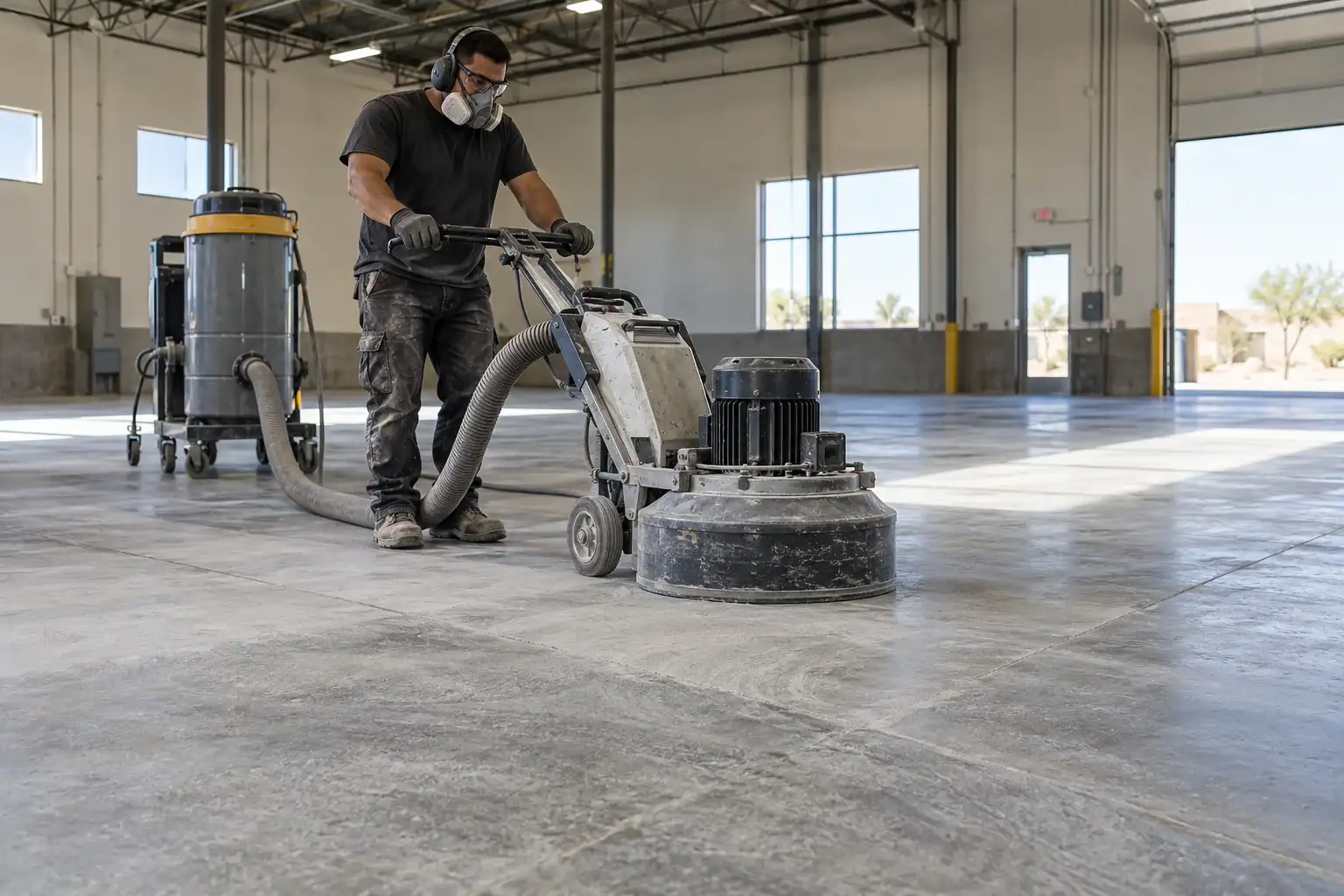
Diamond grinding takes the surface back to sound concrete, cracks and spalls get filled, and each joint gets a fill matched to whether that slab is moving.
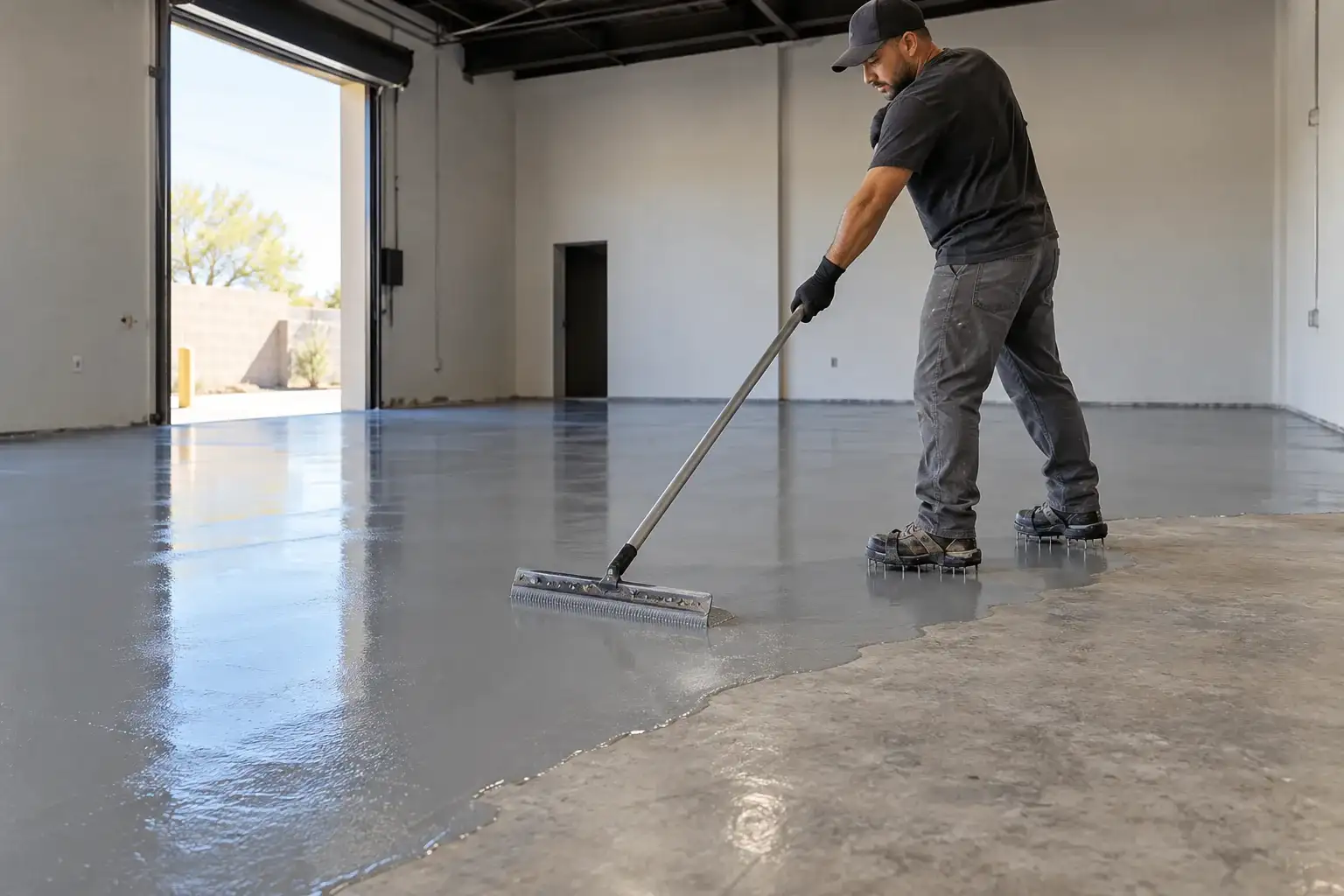
Step 3: The build goes down in one pour window, then the bay stays clear until it cures
A troweled or self-leveling system has to go down while the batch is still open, and the bay stays clear of traffic until the film reaches its rated cure. Call (747) 243-2089 with the bay size and the shift pattern, and we call you back to go over the build and the window.
Costs
What an industrial floor costs per square foot
An industrial floor is quoted per square foot after a site visit, because 3 buildings on the same street can carry 3 different builds. The published national ranges still work as a bracket. An epoxy flooring guide puts professional epoxy across all systems at $3 to $15 per sq ft in 2026, and HomeGuide (opens in a new tab) puts epoxy flooring installed at $4 to $10 per sq ft. The spread is the build: a 60 mil and a 250 mil industrial system are not one purchase.
| Build | Published range | Source |
|---|---|---|
| Epoxy flooring, installed | $4 to $10 per sq ft | HomeGuide (opens in a new tab) |
| Professional epoxy, all systems, 2026 | $3 to $15 per sq ft | Epoxy flooring guide |
| Concrete floor coating, national | $1,250 to $4,000, average $3,000 | Fixr (opens in a new tab) |
| Labor, epoxy garage floors | $4 to $7 per sq ft, or $50 to $150 per hour | Bob Vila (opens in a new tab) |
Published ranges, not a quote.
5 things move that number. Thickness comes first, because a 250 mil build uses several times the material of a 60 mil one over the same square footage. Square footage is second, since mobilization and testing spread thinner across a bigger bay. Joints and cracks are third, and they are measured in linear feet, which is how a 30,000 sq ft slab with tight joints can price lower per sq ft than a 12,000 sq ft slab cut into small pours. Moisture mitigation is fourth, and it only appears when a test says it has to. Downtime is fifth: a Saturday and a Sunday can cost more than 3 weekday nights, and a building that cannot give up a bay at all can cost more again.
Moisture
Moisture decides whether the film stays down
Moisture is named as the leading cause of coating failure, and it works from underneath, so the floor can look finished the day the barricade comes down and lift later, per a garage flooring guide. A Mesa slab under a metal building can hold moisture for reasons that have nothing to do with a roof leak, and a curing compound left on a new slab can cause a bond failure from the top face. The test comes first because the fix is a coat in the build, and the alternative is a tear-out.
Systems
Chemical load and abrasion set the build
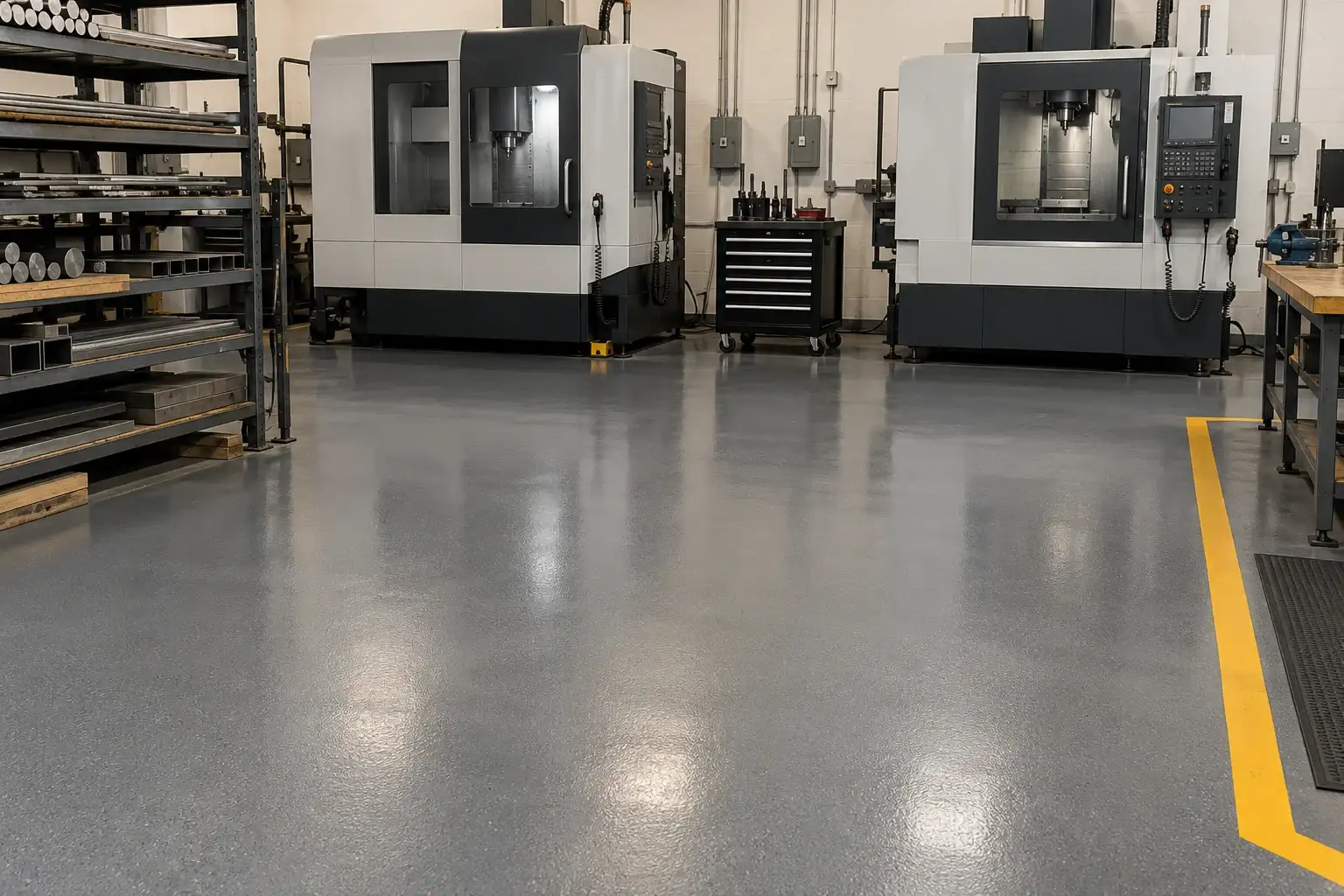
Quartz systems at 40 to 60 mil are the commercial workhorse: the silica broadcast gives a hard wearing surface without the cost of a full troweled mortar. An epoxy flooring guide lists quartz broadcast at 40 to 60 mil. Forklift traffic is an abrasion problem at the drive wheels and a shear problem at every turn. A washdown bay adds thermal shock, because hot water on a cooler slab puts a temperature swing through the film, and repeated swings can open a hairline at a drain edge before the field wears out. Chemical resistance is a separate question from thickness, and it gets answered against the actual fluid: a degreaser, a coolant and a plant sanitizer do not ask the same thing of a coating.
Good to know
The traffic window is part of the specification
Epoxy can take up to a week to cure before a floor is ready for full service (HomeGuide (opens in a new tab)), which is a scheduling fact, not a defect. A polyaspartic topcoat changes the arithmetic, because certain stages can cure in 20 to 60 minutes, and in warm conditions a garage flooring guide puts light foot traffic at 12 hours, everyday use at 24 hours, contents at 48 hours and car traffic at 96 hours. On a building with a loading dock, that difference can matter more than the material it is made from.
5 questions
Questions people ask
Still have a question? Call (747) 243-2089 and describe the floor.
How thick does an industrial floor need to be?
It depends on the traffic and the chemical load. A quartz system at 40 to 60 mil covers many commercial and light plant floors, while a self-leveling or troweled build at 60 to 250 mil is what a heavy forklift bay, a washdown room or a floor with real impact gets, per an epoxy flooring guide's thickness table. The thickness is bought in gallons per 1,000 sq ft, so it shows up in the price.
Can a forklift run on it the next morning?
Rarely on an epoxy build, which can take up to a week to reach full cure (HomeGuide (opens in a new tab)). A garage flooring guide puts a polyaspartic system at car traffic after 96 hours in warm conditions, with light foot traffic from 12 hours, so plan the bay for days rather than one night.
Does the whole building have to shut down?
Not always. Work can move a bay at a time, and a saw cut at a joint gives a clean line to stop on. Dust control and the aisle you need to keep open decide the rest, so tell us where the forklift has to keep running.
What does the moisture test involve?
An in-slab probe reads the humidity inside the concrete rather than the air above it, and a calcium chloride test measures the vapor coming off a measured area over a multi-day test period, reported per 24 hours. The published thresholds are under 75 percent relative humidity by ASTM F2170, or under 3 lb per 1,000 sq ft per 24 hours by ASTM F1869, per an epoxy flooring guide.
Will it take a hot pressure washer?
A troweled or self-leveling build handles washdown better than a thin film, and the details carry as much as the field: a cove at the wall base, a drain ring and a filled joint at every curb. Hot water on a cool slab is thermal shock, so the build gets specified for it.
Keep reading
Related
- Commercial epoxy flooring: for shop floors, kitchens and showrooms.
- Concrete prep and coatings: for grinding, crack repair and moisture testing on their own.
- Polyaspartic and epoxy: when cure speed is the constraint.
- Epoxy flooring cost: for the full published range by system.
- The Mesa epoxy guide: for thickness, testing and cure in one place.
- Phoenix warehouses: and Chandler tech parks for the neighboring slab notes.
- Garage Floor Epoxy: Garage floor epoxy in Mesa comes down to 3 builds: flake, metallic and solid.
- Residential Epoxy Flooring: Call (747) 243-2089
- How an install runs
- Floor looks
- Areas around Mesa