Service 01 of 06 · Mesa, AZ
Mesa commercial epoxy flooring company
You run a shop, a kitchen or a showroom where the slab takes traffic all day, so tell us the square footage, the chemicals and the hours you can shut down, and someone from our team calls you back.
What you get
What you get on a commercial floor
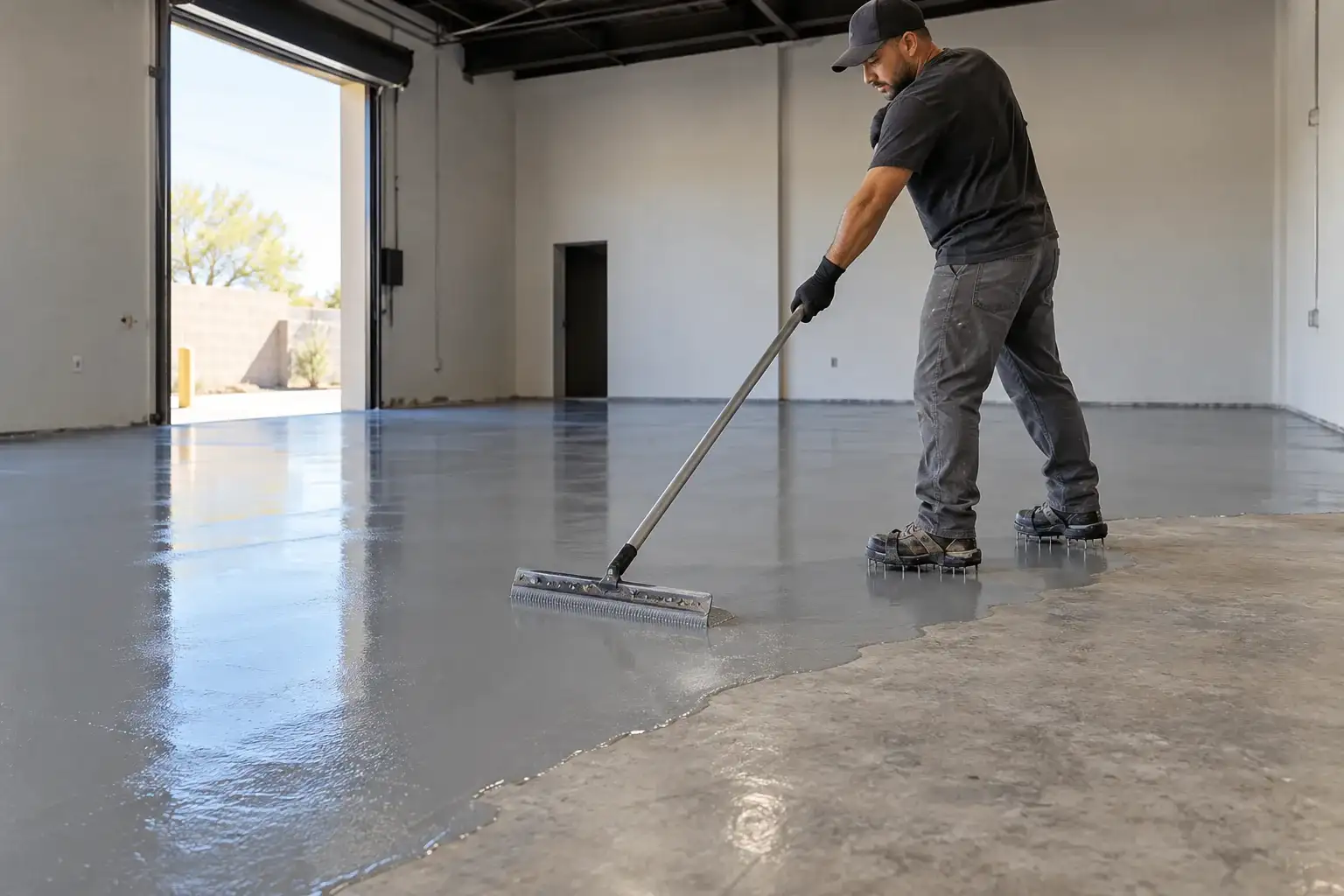
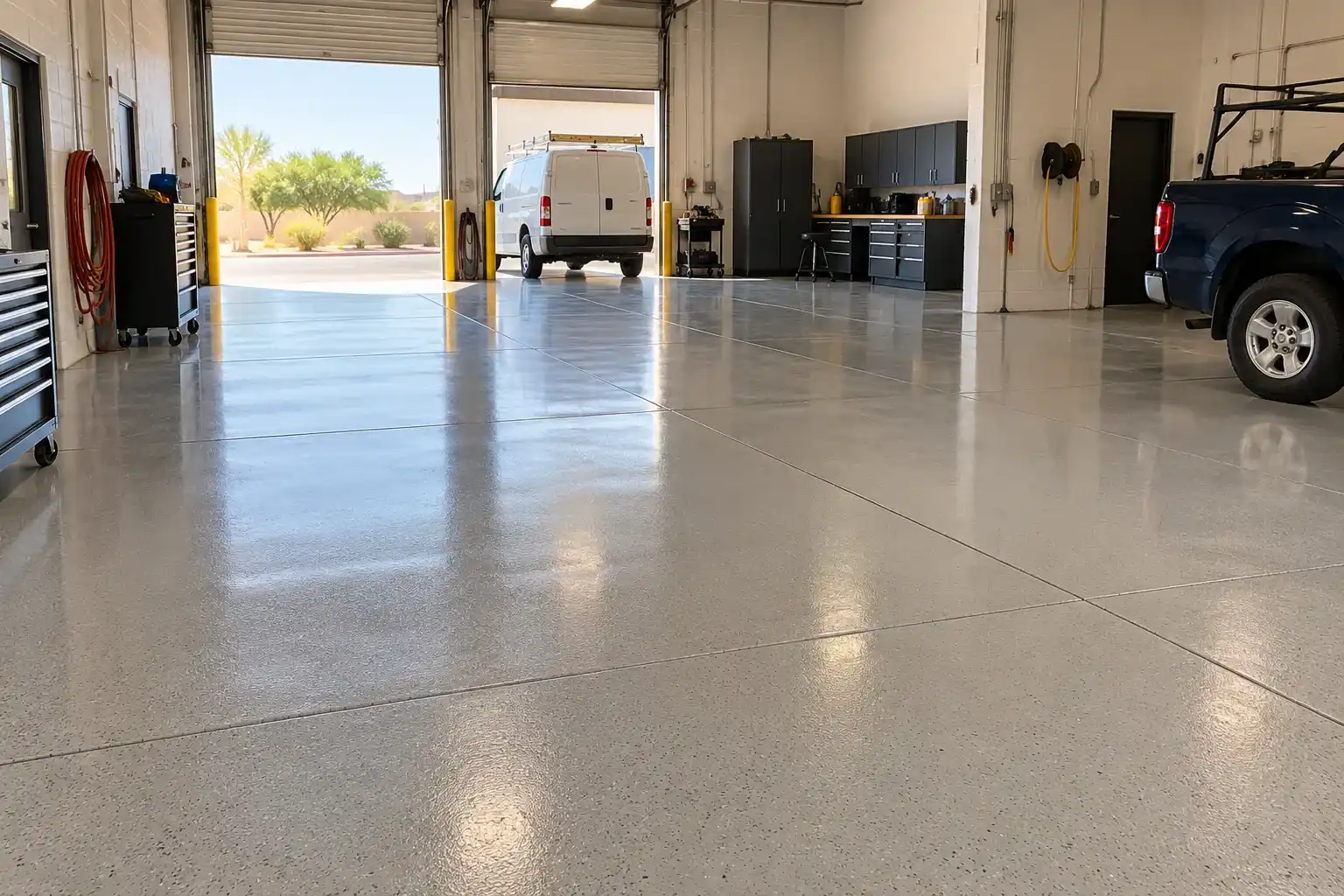
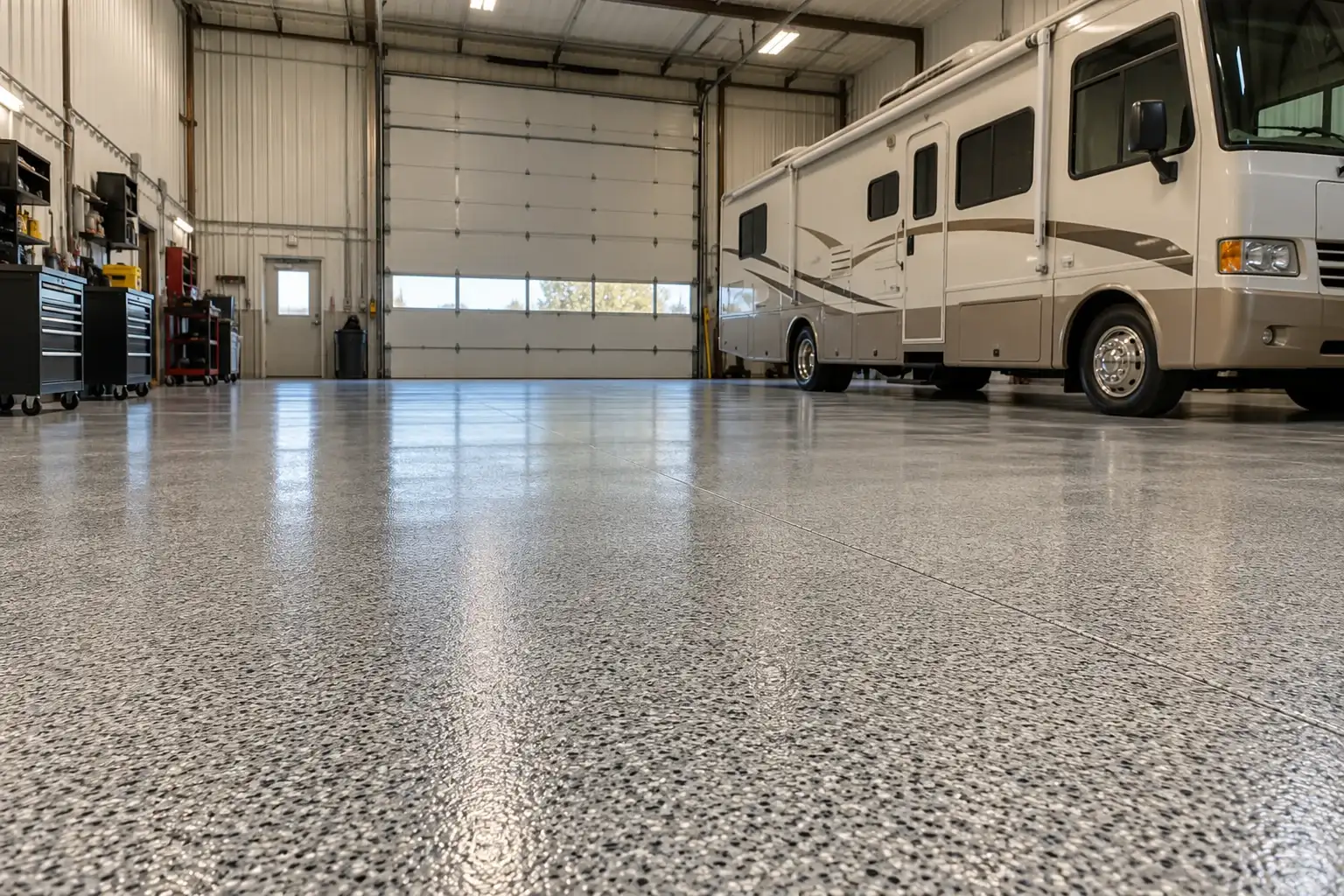
Commercial epoxy flooring in Mesa gets specified around 2 questions: what rolls across the slab, and what gets spilled on it. A quartz broadcast build at 40 to 60 mil dry film is the workhorse for a shop floor or a warehouse aisle, because the silica aggregate stands up to forklift and pallet jack abrasion better than a thin roll-on coat does. A solid epoxy build at 10 to 20 mil under a polyaspartic topcoat suits a showroom, a back office or a light assembly room, and the polyaspartic helps it keep its color where sun comes through a storefront. An epoxy flooring guide lists those dry film numbers by system and defines a mil as one thousandth of an inch, so 40 mil is 0.040 inch over the concrete.
- A surface that still reads as a floor after a shift of pallet jack traffic, not one powdering off at the dock door.
- Kitchen floors that take hot water, degreaser and a nightly hose-down without lifting along the wall.
- Joints and trench drain edges that stay tight, so wash water stays on top of the film.
- A moisture test before anything gets ordered, because moisture in the slab is a leading cause of coatings that bubble or peel.
- A build written by system and dry film thickness, so a 20 mil coat and a 60 mil quartz floor are not priced as one product.
Signs
5 signs your commercial floor is costing you money
Traffic lanes go dull in stripes
The path a forklift takes between the dock and the racking wears thin long before the rest of the floor, and a recoat there can cost less than a rebuild.
The film lifts along a saw joint
A joint that opens and closes with the slab can crack the coating above it, and once wash water gets into the crack the edge can peel back from both sides.
Grease and hot water attack the wall joint in a kitchen
Degreaser and mop water sit against the base every night, so a floor without a chemical-resistant topcoat and a cove can let go from the perimeter inward.
Pallet jack wheels leave gray trails that no longer wipe off
When a scuff sits in the concrete instead of the film, the wear layer is gone and the slab is taking the abrasion directly.
Patches around a trench drain start to rock
A patch feathered over a cold joint or a damp substrate can break loose under a loaded pallet, and each failure can take more floor with it.
3 steps
How a commercial floor gets built
The slab and the operation come first
Traffic type, chemical list, drain locations, joint layout and the hours the business can lose get recorded first.
The slab gets ground, patched and tested
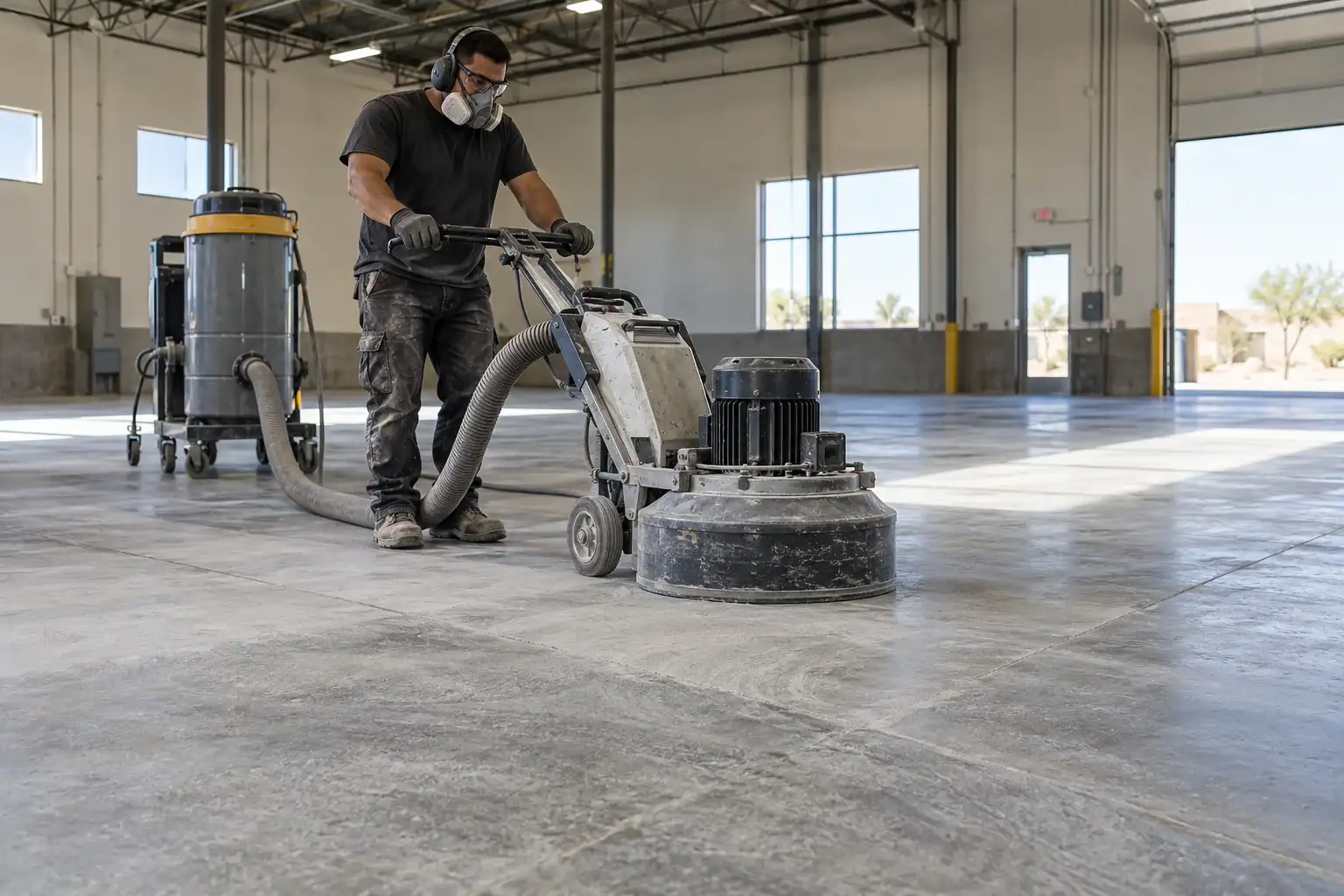
Diamond grinding opens the concrete, cracks and spalls get filled, and a moisture reading settles whether a mitigation coat comes first.
The floor gets coated, cured and handed back
Base coat, broadcast, topcoat, then the cure window, and the space reopens when the film is hard enough to take a loaded pallet.
Costs
What commercial epoxy flooring costs in Mesa
Installed epoxy flooring runs $4 to $10 per sq ft on average, per HomeGuide (opens in a new tab), split into $1 to $5 per sq ft of material and $3 to $5 of labor. A national home cost guide puts epoxy at $3 to $12 per sq ft to install, and an epoxy flooring guide puts professional epoxy at $3 to $15 per sq ft in 2026. The spread is not noise: a thin roll-on coat and a 60 mil quartz build are different products.
| Scope | Published range | Source |
|---|---|---|
| Epoxy flooring, installed | $4 to $10 per sq ft | HomeGuide |
| Materials and labor | $1 to $5 and $3 to $5 per sq ft | HomeGuide |
| Epoxy floor, installed | $3 to $12 per sq ft | National home cost guide |
| Professional epoxy, all systems, 2026 | $3 to $15 per sq ft | Epoxy flooring guide |
Published ranges, not a quote.
The fixed costs do not shrink with the floor. Mobilization, the grinder, the moisture test, the masking and the drive out are the same on a 600 sq ft espresso bar as on a 4,000 sq ft shop, so they land on 600 sq ft instead of 4,000. A small commercial space is also among the slowest square footage in the trade: equipment to work around, a drain and 3 doorways to detail, a long run of cove, and a shutdown that starts at 9 pm. An open warehouse aisle is nearly all field, which is where square footage gets cheap.
A commercial scope lists the system and dry film thickness, the field and cove square footage, joint and crack repair as its own line, the moisture result and any mitigation coat, and the cure window with the hour the floor takes traffic. A coatings manufacturer's technical note cites ANSI/NFSI B101.3 for wet dynamic coefficient of friction and recommends a minimum of 0.42 for a walking surface, a figure a specifier can use for a kitchen floor.
Planning
Traffic lanes and saw joints decide the life of the floor
A commercial slab is cut into panels with saw joints, and those joints move. A slab grows in summer heat and shrinks as it cools, per a garage flooring guide, so a joint paved over with a rigid coating can telegraph a crack up through the film when the temperature swings. The answer is not more coating. The joint gets cleaned out, filled with a semi-rigid material that moves with the slab, and the film carries across a joint with somewhere to go. Traffic lanes are the other clock, and the gap between a 40 to 60 mil quartz build and a 10 to 20 mil solid coat shows up first in the strip where trucks turn.
Use
A kitchen, a showroom and a gym want different floors
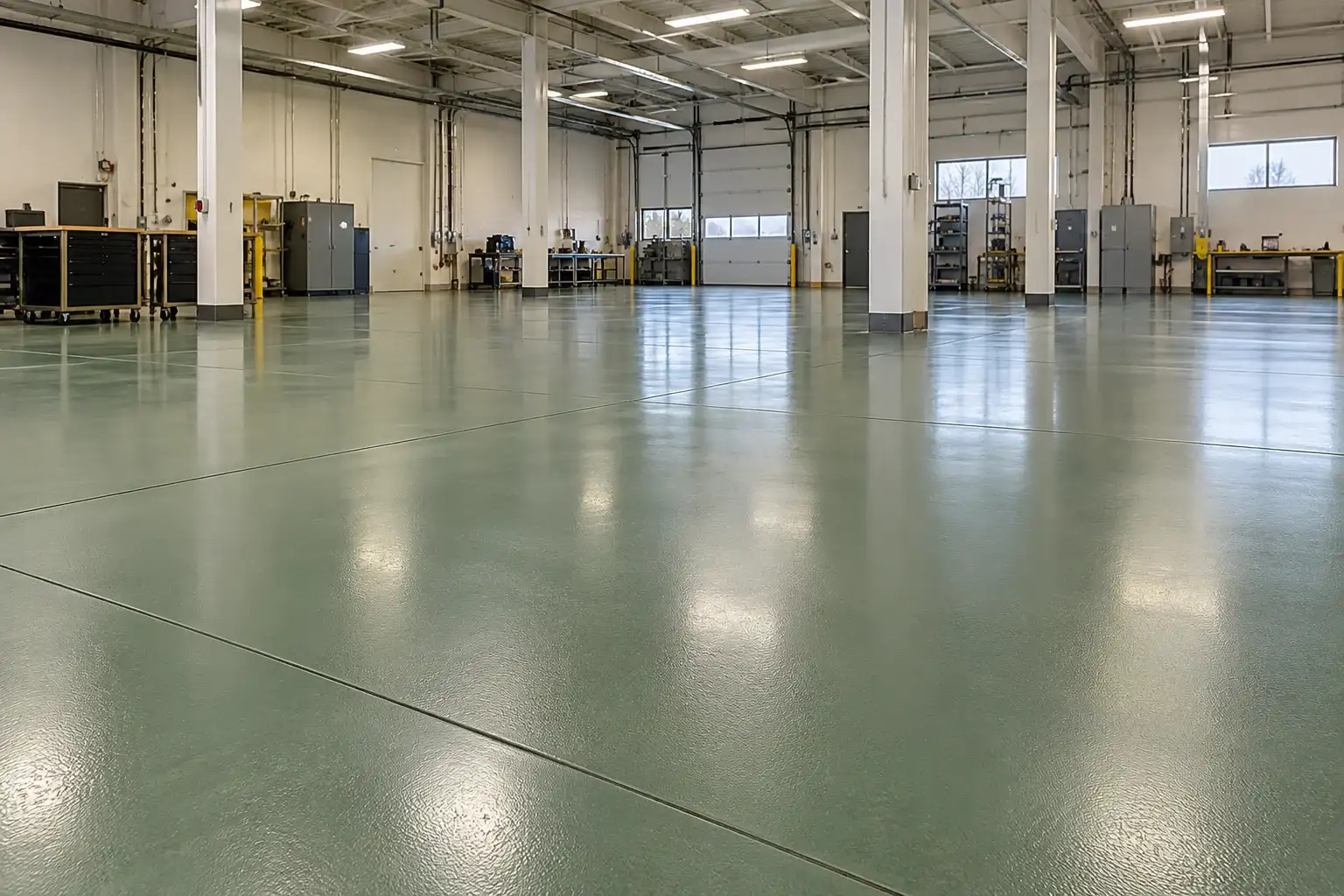
The chemicals decide the topcoat. A restaurant kitchen sees hot water, degreaser and animal fat every night, so the build needs a chemical-resistant topcoat and a cove that lets a hose-down run to the drain. A showroom sees foot traffic and sunlight, so a UV-stable polyaspartic topcoat matters more than abrasion resistance, because epoxy has no built-in UV protection and visibly discolors in sun, per a garage flooring guide. A gym sees dropped dumbbells and rubber feet, which puts the money into film thickness and a topcoat that takes impact. Heat sets the calendar on all 3: epoxy needs air and slab between 50 F and 90 F, and Mesa's July normal high is 106 F with a normal low of 79 F (NOAA NCEI 1991-2020 normals, station USC00022782), so a shop without air conditioning gets coated at night or in October.
Signs
Moisture under the slab is the failure nobody sees
Damp concrete does not hold a coating well, whatever resin is in the pail: the film can blister or peel off in sheets, and a garage flooring guide names moisture as the leading cause of coating failure. An epoxy flooring guide gives the 2 thresholds: under 75 percent relative humidity on an ASTM F2170 in-slab probe, or under 3 lb per 1,000 sq ft per 24 hours on an ASTM F1869 test. A slab with no vapor barrier under it is where a wet reading can turn up, so the test happens before the coating goes down.
4 questions
Questions people ask
Still have a question? Call (747) 243-2089 and describe the floor.
How long before the space takes traffic again?
Cure is the fixed part. In warm conditions a garage flooring guide puts certain polyaspartic stages at 20 to 60 minutes, light foot traffic at 12 hours, everyday use at 24 hours, contents at 48 hours and vehicle traffic at 96 hours, and a polyaspartic commercial floor can run on a similar clock. Grinding, patching and coating fill the days before it; the film sets the hour the doors reopen.
Can the business stay open during the work?
It can be, if the space can be split. Coating half a shop while the other half runs means 2 mobilizations and a taped line down the middle, and the floor takes traffic in sections. A kitchen is harder because the equipment sits on the slab, so kitchen work often lands in a shutdown window. Tell us the hours you can lose, and we go over a plan around them.
What holds up to hot water every night?
A solid epoxy base at 10 to 20 mil with a chemical-resistant polyaspartic topcoat, a cove at the wall and a filled joint at every transition. An epoxy flooring guide puts a polyaspartic topcoat at 3 to 5 mil per coat, and that topcoat is the layer facing the chemistry and the heat. A 3 to 5 mil box-store kit is a poor fit for a wet kitchen.
Does the slab need a moisture test first?
Yes, before a system gets picked. The thresholds are under 75 percent relative humidity on an ASTM F2170 in-slab probe or under 3 lb per 1,000 sq ft per 24 hours on an ASTM F1869 test, per an epoxy flooring guide. If the slab reads wet, the scope adds a mitigation coat, and that line belongs in the budget from the start.
Keep reading
Related
- Garage floor epoxy: for the home slab and hot tires.
- Industrial epoxy flooring: for heavy build warehouse work.
- Concrete prep and coatings: for grinding, patching and moisture.
- Epoxy flooring cost: for the full range by system and size.
- The Mesa guide: for thickness, cure and slip resistance.
- Residential Epoxy Flooring: Call (747) 243-2089
- Polyaspartic and Epoxy: For a Mesa garage, polyaspartic and epoxy are 2 different resins, not 2 brands of the same product, and the reason both turn up in the same garage is that they do different jobs in the build.
- How an install runs
- Floor looks
- Areas around Mesa